Client Background
ACR Canada operates in the restaurant and food service industry, supplying disposable consumables to multi-location dining establishments across Canada. Before this project, their teams were experiencing a recurring issue: disposable PE gloves tearing too easily during prep work, service support, and sanitation routines.
A single glove tear in a food service environment does not just waste one glove. It disrupts shift continuity, increases per-shift glove consumption, and — when it happens consistently across locations — generates customer complaints and erodes staff confidence in the supply chain.
The project goal was to source a PE glove solution tailored for food contact and food service environments, while improving product consistency, supporting on-time delivery, and making consumable management easier across multiple restaurant locations.
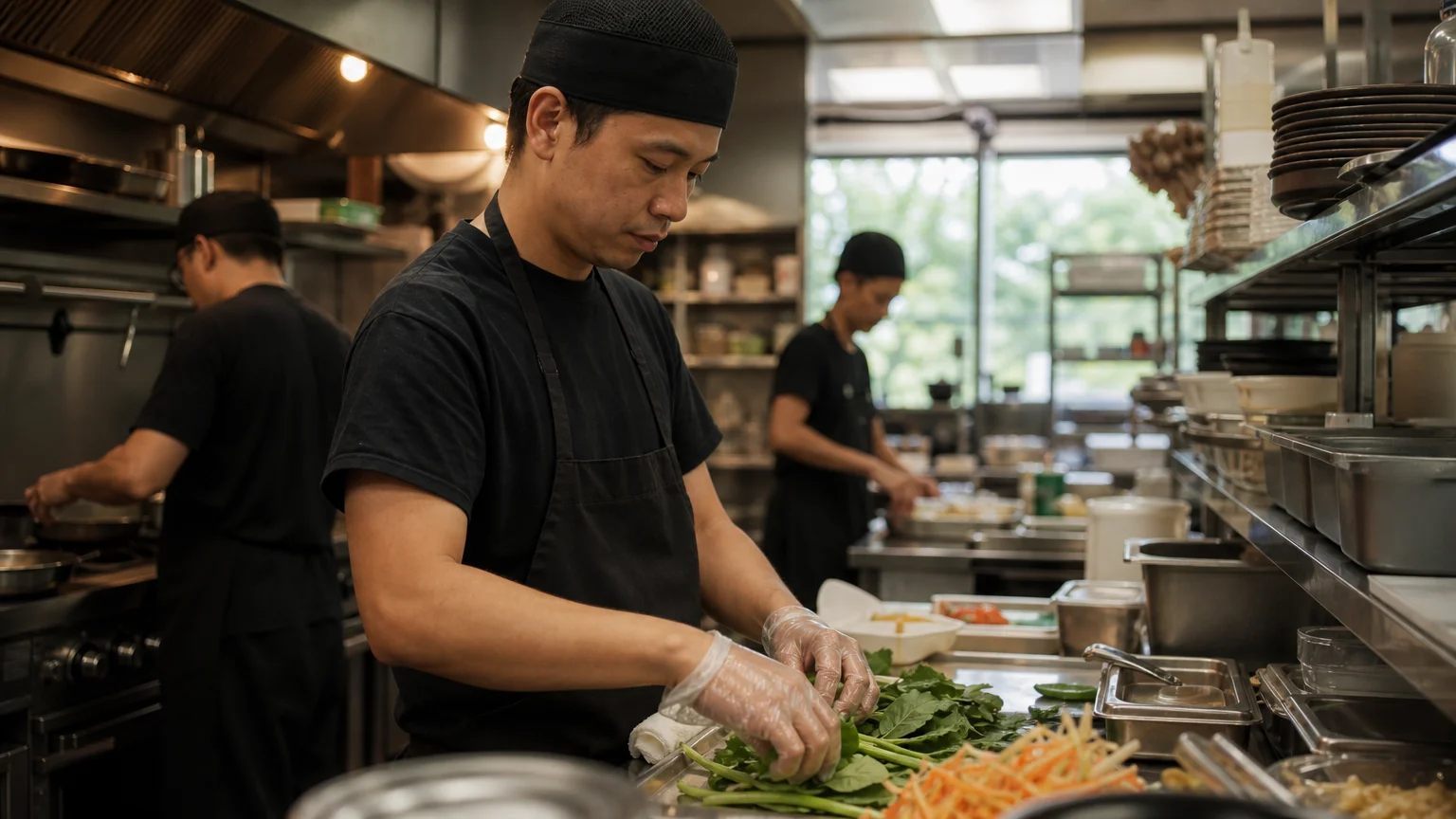
The Challenge: Tear Risk Amplifies Consumable Costs Across Locations
For restaurant buyers, PE gloves must balance hygiene compliance, cost control, ease of donning, and durability. When gloves tear too easily, staff consume more pairs within the same shift window — and the more locations running the same consumable, the larger the problem becomes.
ACR Canada faced three compounding procurement pain points:
- Higher per-shift consumption: Glove tears forced staff to change gloves more frequently within the same service window, directly inflating consumable spend.
- Operational disruption: Frequent glove changes broke service flow and required more staff attention on restocking rather than food preparation.
- Batch-to-batch quality variability: Inconsistent glove performance across repeat orders made procurement forecasting harder and damaged trust in the supplier relationship.
ACR Canada needed more than a product that simply ships on time. They needed a supply partner who could manage material performance, inspection standards, and delivery scheduling together — not as separate concerns.
Our Solution: Disposable PE Gloves Configured for Food Service Environments
Worldchamp supplied disposable PE gloves suited for food contact and food service scenarios, approaching the project from two directions simultaneously: material-side optimization and process-side control.

On the material side, the project team refined the raw material compound formula with a specific focus on improving film toughness — reducing the likelihood of tearing under the physical stress of normal restaurant use. This involved adjusting resin blend ratios to enhance elongation properties without compromising food-contact compliance.
On the production and inspection side, the team strengthened inline QC checkpoints and coordinated production scheduling to support both bulk shipments and the stability demands of repeat orders across multiple ACR Canada locations.
By connecting product formulation, inspection protocols, and delivery planning into a single workflow, Worldchamp helped ACR Canada address glove durability and supply reliability as one integrated problem — not two separate conversations with the factory.
Implementation & Quality Control: Building Batch Consistency for Multi-Location Use
After confirming the food service use scenario, Worldchamp aligned with ACR Canada on product quality requirements, food contact expectations, and delivery timelines. Raw material sourcing, molding, inspection, packaging, and production scheduling were consolidated into a single traceable workflow.
For a consumable project covering multiple restaurant locations, a single passing sample is not sufficient validation. What actually determines the buyer experience is batch-to-batch consistency, packaging format, ease of dispensing at the location level, and replenishment cycle predictability.
The project addressed this through three levers:
- Material optimization: Adjusted compound formula to reduce tear incidence under real kitchen conditions — repeated donning, stretching during prep tasks, and contact with food surfaces.
- Inspection controls: Implemented structured inline QC at critical production stages, with sampling protocols calibrated to catch batch-level deviations before shipment.
- Production scheduling: Coordinated production runs to align with ACR Canada's replenishment cycles, reducing the risk of stockouts across locations.

Results & Impact
- Reduced tear-related waste: Glove tear incidence dropped meaningfully after the material compound adjustment, lowering per-shift glove consumption across ACR Canada locations.
- Improved delivery reliability: Coordinated production scheduling eliminated the supply gaps that had previously disrupted restocking cycles.
- Stronger batch consistency: Structured inline QC reduced batch-to-batch performance variation, giving ACR Canada's procurement team more confidence in repeat orders.
- Lower procurement overhead: Consolidating material, inspection, and logistics communication into one supplier contact reduced the back-and-forth that had driven up order management time.
By addressing both material performance and supply process discipline, the project reduced tear-related glove waste across ACR Canada's locations and improved the predictability of replenishment cycles. Batch consistency across repeat orders increased confidence in forward planning — reducing the reactive procurement scrambles that had previously driven up communication and logistics overhead.
"Product quality control is very good, delivery time is reliable — exactly what we need for bulk use across our restaurant locations."
Takeaway for Similar Buyers
This case illustrates that disposable glove procurement for restaurant and food service cannot be evaluated on unit price alone. Material compound, film thickness and toughness, edge sealing quality, batch inspection protocols, packaging format, and delivery scheduling all affect the buyer's true cost of use and procurement risk.
For multi-location food service operators, the hidden cost of a glove that tears at slightly-above-average rates is not the gloves themselves — it is the disruption multiplied across every shift, every location, every reorder cycle. Evaluating suppliers on total supply management capability, not just price per case, is the more accurate frame for this category.
Need Reliable PE Gloves for Your Restaurant or Food Service Operation?
Share your glove size, thickness preference, packaging requirements, target market, and order volume — Worldchamp will assess the right supply configuration for your locations.
FAQ: 5 Optimization Questions
1. Are Worldchamp disposable PE gloves suitable for food service use?
Worldchamp supplies disposable PE gloves suitable for food contact and food service environments. Restaurant buyers are advised to confirm local food contact compliance requirements, glove size, film thickness, packaging format, and specific use scenarios — whether for kitchen prep areas or front-of-house service — before placing an order.
2. How can food service operators reduce PE glove tear risk?
Tear risk in food service gloves typically requires controlling material compound, film thickness, edge sealing quality, and inspection processes together. In this project, Worldchamp used raw material compound optimization and structured inspection controls to improve film toughness and reduce tear-related consumable waste at the location level.
3. Do international PE glove orders have a minimum order quantity?
International orders require a sustainable minimum order quantity (MOQ). Restaurant chains, distributors, and wholesale buyers should confirm MOQ together with glove specifications, packaging format, carton count, and repeat purchase schedule to ensure supply program feasibility.
4. What are typical sample and bulk order lead times?
Samples typically take around 7 days. Bulk orders typically ship within 20–30 days after deposit confirmation and final product sign-off. Food service PE glove projects are advised to confirm order timelines in advance to support location-level restocking schedules without gaps.
5. Can Worldchamp support safe packaging and shipping for bulk PE glove orders?
Yes. Worldchamp uses high-quality export packaging; freight cost depends on quantity, weight, and shipping method. For bulk PE glove orders, buyers are advised to confirm carton configuration, pallet format, shipping method, and destination market before requesting a final quote.