Define the contact type and duration
Record direct or indirect food contact, temperature, moisture, oil, seasonings and any utensils handled during the step.
Food handling glove supplier
Match the workstation, pack and sample to PE, CPE, TPE or POE. Material choice for disposable food contact gloves is explained in the material guide.
Food-contact suitability, migration limits and labeling requirements depend on the exact SKU and destination market. Request the applicable documents before approval.

Selection sequence
Hold the task constant, compare glove performance and verify the evidence for the exact SKU and destination market.

Record direct or indirect food contact, temperature, moisture, oil, seasonings and any utensils handled during the step.
For frequent short tasks, prioritize easy donning and economical dispensing. For longer wear, give more weight to fit, feel and stay-on performance.
Test bags, dispenser boxes, book-folded packs or paired packs at the actual workstation, with workers taking and changing gloves as they normally would.
Search terms vary, but approval still depends on the exact SKU. Food-service and food-preparation gloves should be evaluated for the actual task and supported by applicable food-contact documentation. First-aid or medical-use labeling does not by itself establish food-contact suitability.
Common procurement risks
The lowest unit price can be offset by difficult opening, double withdrawal, tearing, excessive change time or evidence that does not match the ordered glove.

A broad label does not identify the exact formulation, dimensions, thickness, manufacturing route or destination evidence supporting the supplied SKU.
Resolve this before approving the sample and specification for repeat orders.
Workers compensate for poor dispensing by touching multiple gloves, slowing changes or wasting pieces.
Different foods, users or durations make the comparison subjective and difficult to reproduce.
Approval checks
Record the acceptance result beside the sample code so procurement, quality and users share one baseline.
Food type, temperature, moisture, oil, duration and utensils
Donning, hand feel, tearing, grip and replacement frequency
Opening, single withdrawal, count, station footprint and carton
Exact SKU, destination, food-contact documents and approved wording
Food-contact evidence
Food-contact suitability is decided by the finished SKU and the destination market. Keep the framework, the product evidence and the factory certificate as three separate questions.
Record direct or indirect contact, food type, temperature, fat or acid content and contact duration for every workstation you are equipping.
US buyers commonly reference FDA 21 CFR food-contact provisions; EU buyers reference Regulation (EU) No. 10/2011 for plastic food-contact materials. Confirm which framework your buyer actually requires before ordering.
Request the migration or material test report for the exact glove, with sample identity, test method, laboratory, report date and the market it supports.
Check that the supplier declaration names the same material, dimensions and SKU you intend to order, rather than a generic product family.
A BRCGS Consumer Products or ISO 9001 certificate describes the factory management system and its manufacturing scope; it does not by itself prove food-contact suitability for a finished glove. Hygiene and HACCP programs also use glove colour for zone coding, which is why blue film gloves are common in food plants — colour supports a written control, it does not replace it. For the full verification sequence, see the food contact glove compliance checklist and the PE gloves food safety guide.
Recommended product options
Use the same workstation test to separate economical frequent-change options from softer or more structured film routes.

A softer, more flexible film route for buyers who prioritize hand feel during repeated preparation steps.
Review this route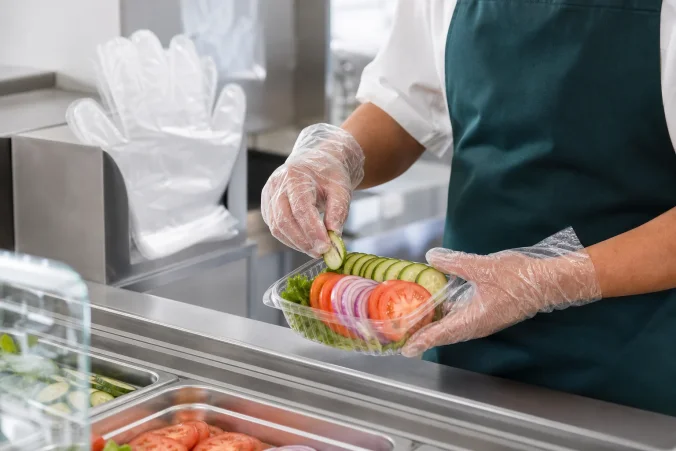
A lightweight, cost-focused route for high-frequency changes and simple short-duration handling.
Review this route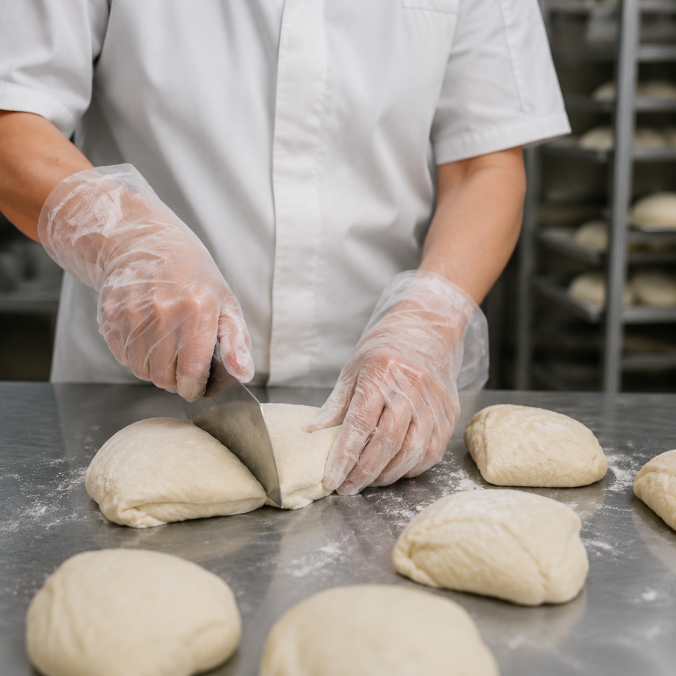
An embossed film route with more structure and easier separation for selected food-service stations.
Review this routeConnected sourcing paths
Product approval should align with the food-processing workflow and a clear route for documents and samples.
Compare short, long-cuff, dispensing and alternative-material formats.
Open related guidance 02Connect issue points, zone practices and change frequency to the selected specification.
Open related guidance 03Send the task, destination, pack preference and evidence list for a focused response.
Open related guidanceBuyer questions
Final answers depend on the exact SKU, intended use, destination, buyer standard and supplied evidence.
There is no universal best material. Compare candidates using the same food, duration, movement, change frequency and pack method, then confirm applicable food-contact evidence for the exact SKU.
No. Medical positioning and food-contact suitability are separate evidence questions. Review the intended contact and destination requirements for the ordered glove.
Check how easily one glove is withdrawn, whether neighboring gloves are touched or pulled out, opening speed, count accuracy and pack durability at the real workstation.
Color can be discussed, but it should support—not replace—written zone controls, SKU identification and the approved specification.
It means the finished glove is intended to touch food, or surfaces and utensils that food touches. Direct contact, food type, temperature and contact duration all change what evidence your buyer will accept.
Ask for it whenever a buyer or market requires product-level food-contact evidence. Match the report to the exact material, dimensions and SKU you are ordering, and confirm its date and scope are current.
Start with a bounded application brief
Worldchamp can then match a product option, sample plan, packaging path and applicable evidence to the intended workflow.
We use necessary cookies to operate this site and optional cookies to improve your experience.