Nitrile Glove Alternatives: A POE, TPE & CPE Buying Guide
The Short Answer on Nitrile Glove Alternatives
The best nitrile glove alternatives in 2026 are POE, TPE, and CPE gloves for most food, beauty, and light industrial buyers, and vinyl or neoprene for buyers who need chemical resistance close to nitrile. Latex is still an option, but allergen and regulation pressure keeps shrinking its share.
Nitrile prices have stayed high since the 2025 spot surge, and many distributors now mix a second material into their program to control cost. The catch is that most best nitrile alternative lists stop at vinyl, latex, and neoprene. They miss POE gloves — a polyolefin elastomer that gives a nitrile-like feel at a lower, more stable price.
Why trust this guide: Worldchamp has manufactured PE, CPE, TPE, and POE disposable gloves since 1997 and pioneered the industry-first POE glove in 2024. The factory holds BRCGS Consumer Products Certificate No. CN-BRCCP-251634 and ISO 9001 Certificate No. 77067/A/0001/UK/En, with a Class 100,000 clean workshop and a <0.1% defect rate. All material and capacity data in this guide comes from that production base.
This guide compares every common nitrile alternative on the metrics buyers actually use — elasticity, strength, chemical fit, food-contact paperwork, and cost stability — then gives you a decision table by use case. POE is one answer, not the only answer; the goal is to help you pick the right mix for your line.
Why Nitrile Got Expensive in 2025
Nitrile is a synthetic rubber made from acrylonitrile butadiene. It became the default medical and food glove because it resists many chemicals and carries no natural latex protein. You can read the material background at Wikipedia, Nitrile rubber.
That default is now costly. Nitrile feedstock is tied to oil and gas chemistry, so raw material swings pass straight to glove prices. Industry tracking shows the nitrile gloves market growing at a strong compound rate while supply stays tight — a mix that keeps unit prices elevated rather than easing back to pre-2020 levels. You can see the market data at Precedence Research, nitrile gloves market.
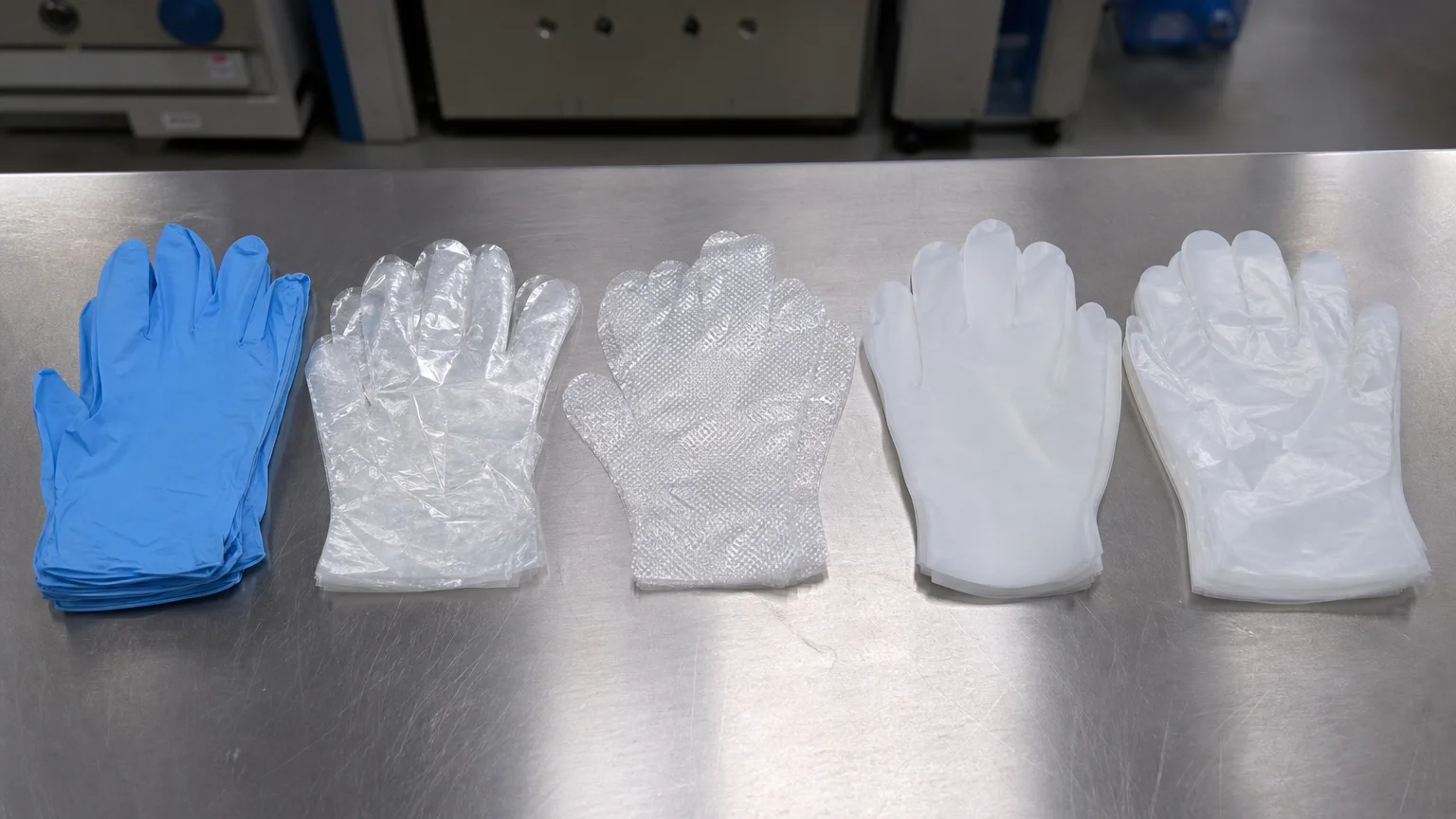
For buyers, the practical signal is simple. A single-material nitrile program now carries price risk every order cycle. Adding a second, lower-volatility material is no longer a nice-to-have — it is basic procurement hygiene. The next section sorts the realistic options.
Nitrile Alternative Materials Compared
Most SERP results list four or five alternatives and stop. The list below covers the full field, including the two polyolefin options that mainstream lists skip. Each entry says what the material is, where it shines, and where it falls short.
Vinyl (PVC) Gloves
Vinyl gloves are made from polyvinyl chloride. They are cheap, loose-fitting, and fine for short, low-risk tasks. They tear more easily than nitrile and offer weaker chemical resistance, so they suit food prep and light cleaning rather than medical or chemical work.
Latex (Natural Rubber) Gloves
Latex has excellent elasticity and tactile feel, which is why it dominated before nitrile. The problem is the latex protein allergen. Many workplaces now run latex-free policies, and several regions restrict latex in food and medical settings. Latex is a real alternative only where the allergen risk is accepted.
Neoprene Gloves
Neoprene is a synthetic rubber close to nitrile in chemical resistance — it handles oils, organic acids, and alkalis well. It is a strong substitute for high-hazard work, but it is priced like a premium rubber, so it does not solve the cost problem that pushes buyers off nitrile.
TPE (Thermoplastic Elastomer) Gloves
TPE gloves are a polyolefin-based elastomer. They stretch and recover better than PE, feel softer, and cost less than nitrile. TPE fits food service, salon, and cleaning tasks that need some stretch but not chemical resistance. Worldchamp TPE gloves carry an SGS food contact test report, so they have product-level food paperwork rather than factory certification alone.
CPE (Cast Polyethylene) Gloves
CPE gloves are a tougher polyethylene film, usually embossed for grip. They cost less than nitrile, resist mild chemicals, and work for cleaning, food prep, and longer household tasks. They are stiffer and less stretchy than TPE or POE, so they suit jobs where durability matters more than fit.
PE (Polyethylene) Gloves
PE gloves — HDPE and LDPE — are the cheapest food glove on the market. They are loose, thin, and meant for very short tasks where you change gloves often. PE is the right pick for sandwich shops, deli counters, and bulk food handling where cost per glove is the main driver. See TPE vs PE gloves for the full trade-off.
POE (Polyolefin Elastomer) Gloves — the Overlooked Option
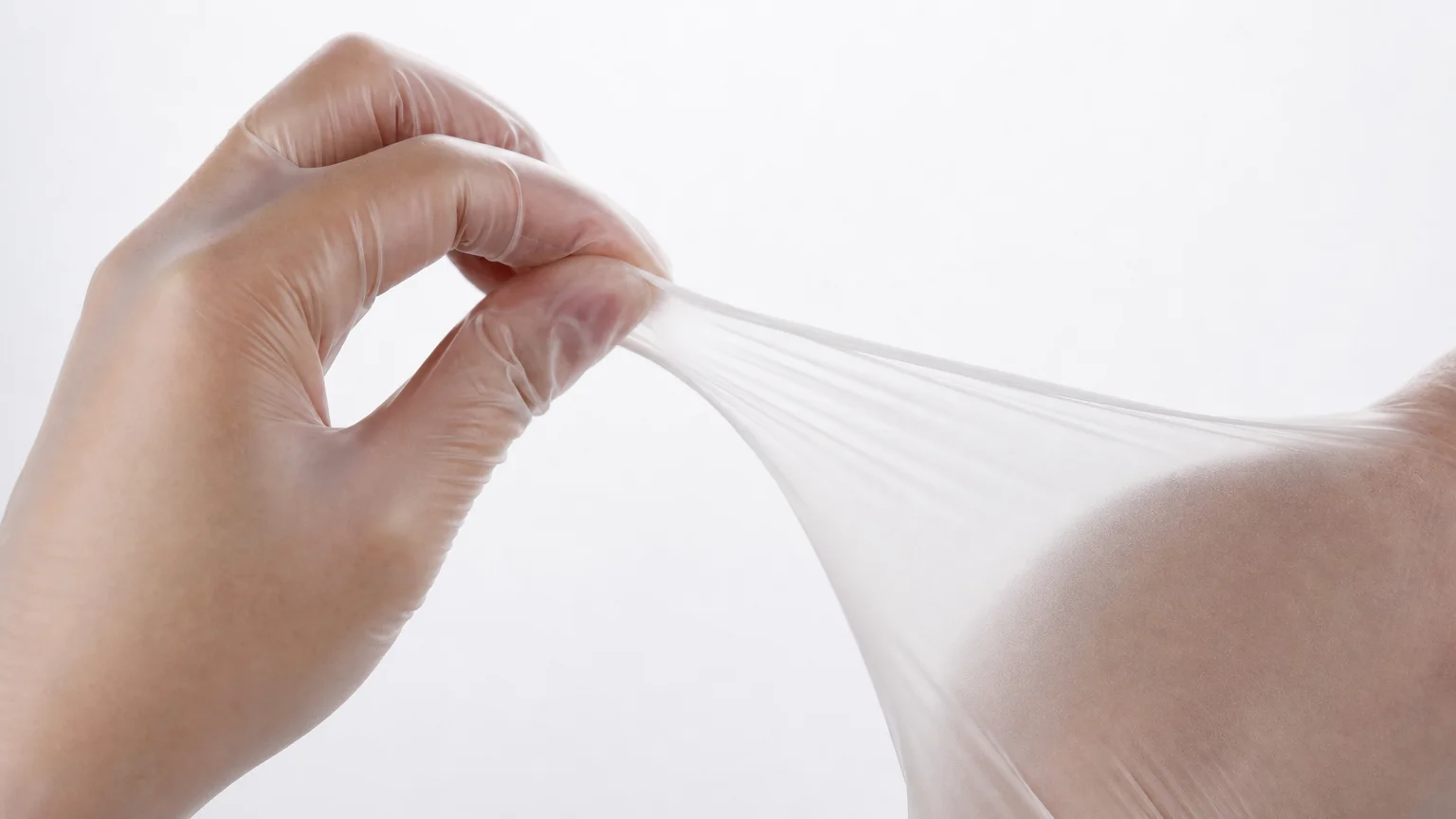
POE gloves are the alternative most lists miss. POE is a polyolefin elastomer — the same polymer family as TPE — but tuned for a softer, more nitrile-like feel. Worldchamp pioneered the industry-first POE glove in 2024. The result is a glove that stretches like nitrile, carries no latex protein, and runs on a polyolefin cost base rather than a rubber one.
POE fits food contact, light lab work, and beauty tasks where buyers want nitrile-like comfort without nitrile-like price swings. The closest variant is Worldchamp sub-nitrile elastic POE gloves, engineered to mimic the nitrile feel for longer wear. If you want the technical background, see sub-nitrile POE technology.
POE and Sub-Nitrile: Why the Mainstream Lists Miss It
POE gloves sit in a blind spot. Most best nitrile alternative roundups are written by rubber-glove manufacturers or retailers whose catalogs stop at vinyl and neoprene. They list what they sell. POE is a newer polyolefin glove, launched commercially in 2024, so it has not yet entered those lists even though it directly answers the nitrile price problem.
That gap is an opportunity for buyers who find it first. POE gives you a nitrile-like feel on a material whose feedstock does not ride the same oil-and-rubber volatility cycle. For a deeper material comparison, see POE vs nitrile glove materials, and for the cost logic, see POE cost reduction vs nitrile gloves.
When POE Beats the Other Alternatives
- You want nitrile-like feel, not just a cheaper glove. POE stretches and recovers closer to nitrile than PE, CPE, or vinyl.
- Your cost swings with nitrile feedstock. POE runs on a polyolefin cost base, which is more stable across an order cycle.
- You need latex-free with comfort. POE carries no latex protein and is softer than CPE.
- You serve food, salon, or light lab tasks. These are the use cases where POE comfort edge shows without needing heavy chemical resistance.
POE is not the answer for high-hazard chemical work. For solvent, chemotherapy drug, or strong-acid exposure, nitrile or neoprene still leads. The honest framing is that POE is the best sub-nitrile option for the majority of routine tasks that do not need that chemical ceiling.
Decision Table by Use Case
Use the table to match a use case to a material. Cost stability rates how much the unit price swings with feedstock markets — high means more predictable across an order cycle. Food paperwork notes whether the material commonly has product-level food-contact documentation at Worldchamp.
| Use case | Best alternative | Why it fits | Cost stability | Food paperwork |
|---|---|---|---|---|
| Short-task food prep (sandwich, deli) | PE gloves | Cheapest per glove; change often | High | Factory certified |
| Food service with some stretch | TPE gloves | Softer fit; SGS food contact tested | High | SGS food contact report |
| Food handling wanting nitrile-like feel | POE gloves | Nitrile-like comfort on stable cost | High | Factory certified |
| Cleaning and household | CPE gloves | Embossed grip; mild chemical fit | High | Factory certified |
| Salon and hair coloring | TPE or POE | Stretch and comfort for long wear | High | Varies |
| Light lab and medical auxiliary | POE gloves | Comfort plus clean production | High | Factory certified |
| Chemical or solvent exposure | Neoprene | Closest chemical resistance to nitrile | Low | N/A |
| Lowest unit price, low risk | Vinyl gloves | Cheap but tears easily | Medium | Varies |
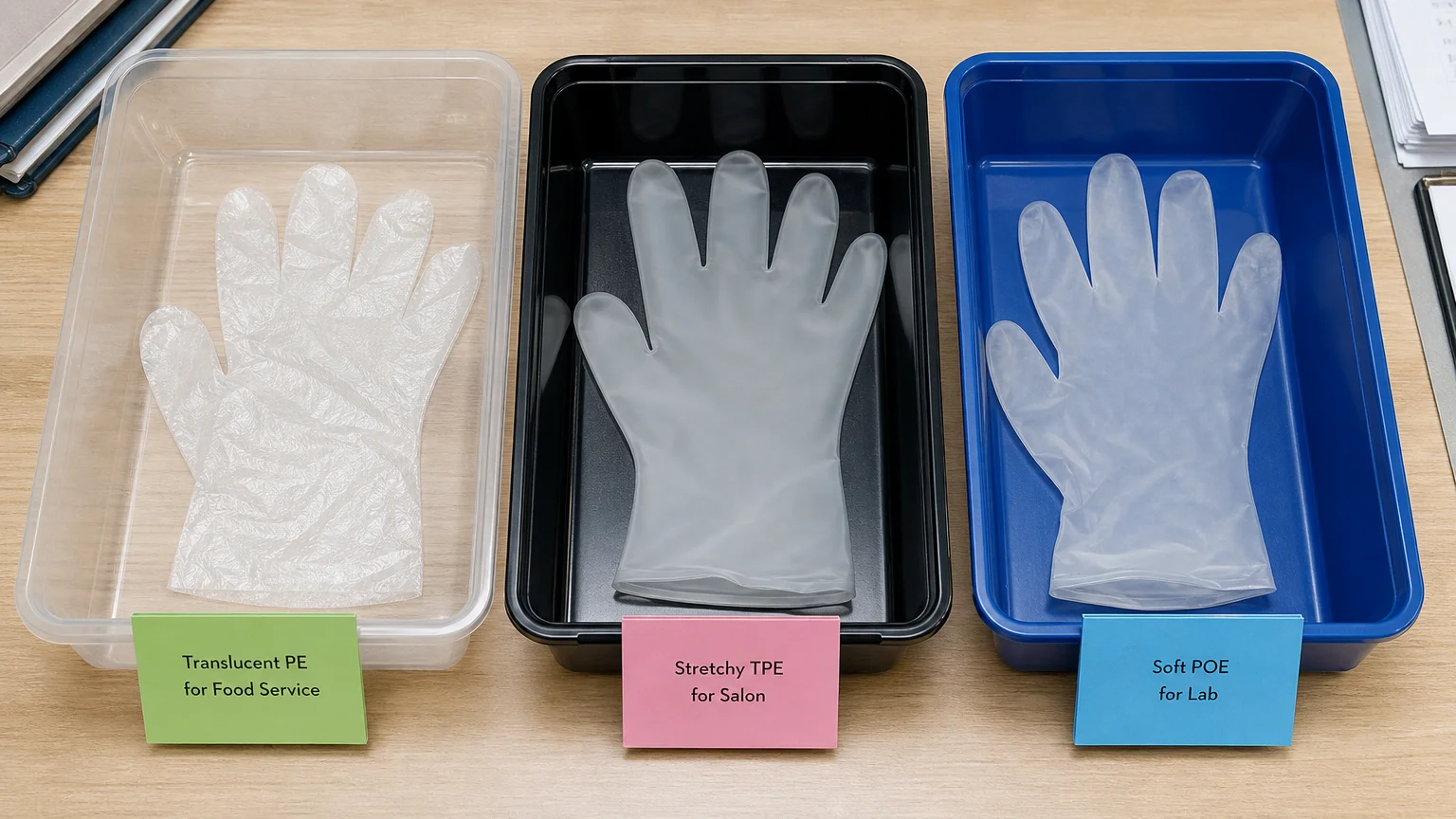
Most buyers end up with a two-material program: a cheap PE or vinyl glove for high-volume short tasks, plus a comfort glove — TPE or POE — for longer wear. That mix cuts nitrile spend without dropping service quality. If you are evaluating the broader supplier picture, see top disposable glove manufacturers.
What to Ask a Supplier Before Switching
Switching materials is cheap to test and expensive to get wrong. Before you commit, ask the supplier five questions. The answers tell you whether the alternative will hold up in your buyer market.
- Confirm the application and wear time. A 10-minute deli task and a 2-hour salon shift need different materials. State the task first.
- Ask for product-level food-contact paperwork, not just factory certs. BRCGS and ISO 9001 cover the quality system; they are not product food-contact certification. For TPE, request the SGS food contact test report.
- Request samples in your real task. Wear them for the actual shift length before quoting. Comfort and tear rate show up only in use.
- Check cost stability across the order cycle. Ask how the unit price tracks feedstock, and whether POE or polyolefin pricing is more stable than nitrile for your volume.
- Confirm latex-free and allergen status. All the polyolefin options here are latex-free, but get it in writing for your compliance file.
For a structured approach to qualifying any glove supplier, see food safe gloves supplier guide. For the OEM angle — custom packaging, private label, low MOQ — see how to choose disposable gloves OEM manufacturer.
Worldchamp Manufacturing Context
Worldchamp runs a 12,000 m² facility in Huizhou, China, with a Class 100,000 clean workshop and full automated lines. Daily capacity reaches 20 tons, monthly capacity 350 tons, and the defect rate stays under 0.1%. That scale matters when you switch materials, because you need a supplier who can run POE, TPE, CPE, and PE on the same program without lead-time gaps.
The factory is the formulator of PE glove industry standards and pioneered the POE glove in 2024. It holds BRCGS Consumer Products Certificate No. CN-BRCCP-251634 and ISO 9001 Certificate No. 77067/A/0001/UK/En. TPE gloves carry an SGS food contact test report and a California Prop 65 test report. PE products carry a REACH (EU) inspection report. These are the documents your compliance team will ask for.
Order terms are built for trial-then-scale. The MOQ is USD 3,000, samples ship in about 7 days, and bulk lead time runs 20–30 days after deposit. That lets you test POE or TPE against nitrile in one trial order before committing volume. L'Oréal has been supplied since 2016, and US FOOD distributors are served for food packaging consumables.
Procurement Action Checklist
- List your tasks by wear time and risk. Split short food tasks from longer comfort tasks before picking a material.
- Pick a two-material mix. Lead with PE or vinyl for volume; add TPE or POE for comfort where nitrile-like feel matters.
- Request POE and TPE samples. Test them in the actual shift length before you quote.
- Collect product-level food-contact paperwork. Ask for the SGS report on TPE; confirm what each material carries.
- Compare cost stability, not just unit price. Ask how each material tracks feedstock across your order cycle.
- Trial with a low-MOQ order. Use the USD 3,000 MOQ to switch one SKU before scaling the program.
Switching Off Nitrile? Test POE and TPE First.
Tell us your task, wear time, and target market. We will match the right material, send a POE + TPE + CPE sample pack, and quote with the compliance documents your buyer needs.
Frequently Asked Questions
What is the best alternative to nitrile gloves?
For most food, beauty, and light industrial tasks, POE, TPE, and CPE gloves are the best alternatives. POE gives the closest nitrile-like feel on a more stable polyolefin cost base. TPE adds stretch for food service and salon work. CPE suits cleaning. For chemical or solvent exposure, neoprene is the closest substitute to nitrile, though it does not solve the cost problem.
Are POE gloves a good substitute for nitrile?
Yes, for routine food, light lab, and beauty tasks. POE stretches and recovers like nitrile, carries no latex protein, and runs on a polyolefin cost base that is less volatile than nitrile rubber. POE is not suited to high-hazard chemical or solvent work, where nitrile or neoprene still leads. Worldchamp pioneered the industry-first POE glove in 2024.
Which nitrile alternative is cheapest?
PE gloves are the cheapest per glove, followed by vinyl. Both suit short, low-risk tasks where you change gloves often. The cheaper option is not always the better value — a slightly costlier TPE or POE glove that lasts longer per wear can cut total program cost. Compare cost per wear, not just cost per glove.
Are TPE, CPE, and POE gloves latex-free?
Yes. TPE, CPE, PE, and POE are all polyolefin materials and contain no natural latex protein. They fit latex-free policies. Worldchamp TPE gloves also carry an SGS food contact test report and a California Prop 65 test report for buyers who need product-level documentation.
What MOQ and lead time should I plan for when switching materials?
Worldchamp runs a USD 3,000 MOQ, ships samples in about 7 days, and delivers bulk in 20–30 days after deposit. That lets you trial POE or TPE against nitrile in one low-commitment order before scaling. Request a sample pack with your target material before quoting volume.