The Short Answer on Choosing a Disposable Gloves OEM Manufacturer
To choose a disposable gloves OEM manufacturer, look past the price quote and audit the factory as a long-term partner. The right maker combines real production capacity, third-party compliance documents, a workable minimum order quantity (MOQ), and a documented sample-to-bulk process. A manufacturer that can show you a BRCGS Consumer Products Certificate No. CN-BRCCP-251634 and an ISO 9001 Certificate No. 77067/A/0001/UK/En is far safer than one that only promises low prices.

This guide walks through the six dimensions that separate a reliable OEM glove factory from a trading desk. It is written for importers, distributors, and brand owners who are qualifying a supplier for repeat orders, not a one-time purchase.
What a Disposable Gloves OEM Manufacturer Actually Does
An OEM (Original Equipment Manufacturer) glove factory produces gloves to your specification and packs them under your brand. You define the material, size, thickness, color, and packaging. The factory runs the compound formulation, film blowing, cutting, and bagging. This differs from buying ready-made stock, where you take whatever the factory already produces.
OEM is also different from ODM (Original Design Manufacturer). With OEM, you bring the design and the factory executes it. With ODM, the factory offers its own proven design and you apply your label. Most glove buyers start with OEM on a standard material like PE or TPE, then move toward private label packaging as volume grows. If you are weighing the two models, see OEM vs ODM disposable products for a side-by-side breakdown.
Knowing this distinction matters because it changes what you must verify. An OEM partner must prove it can hold your spec across batches. A pure reseller only needs to have stock on hand.
The Six Dimensions to Evaluate a Disposable Gloves OEM Manufacturer
Use these six dimensions as a checklist during supplier qualification. Each one answers a specific risk that catches buyers later — usually after the first container ships.
1. Real Production Capacity, Not a Sales Number
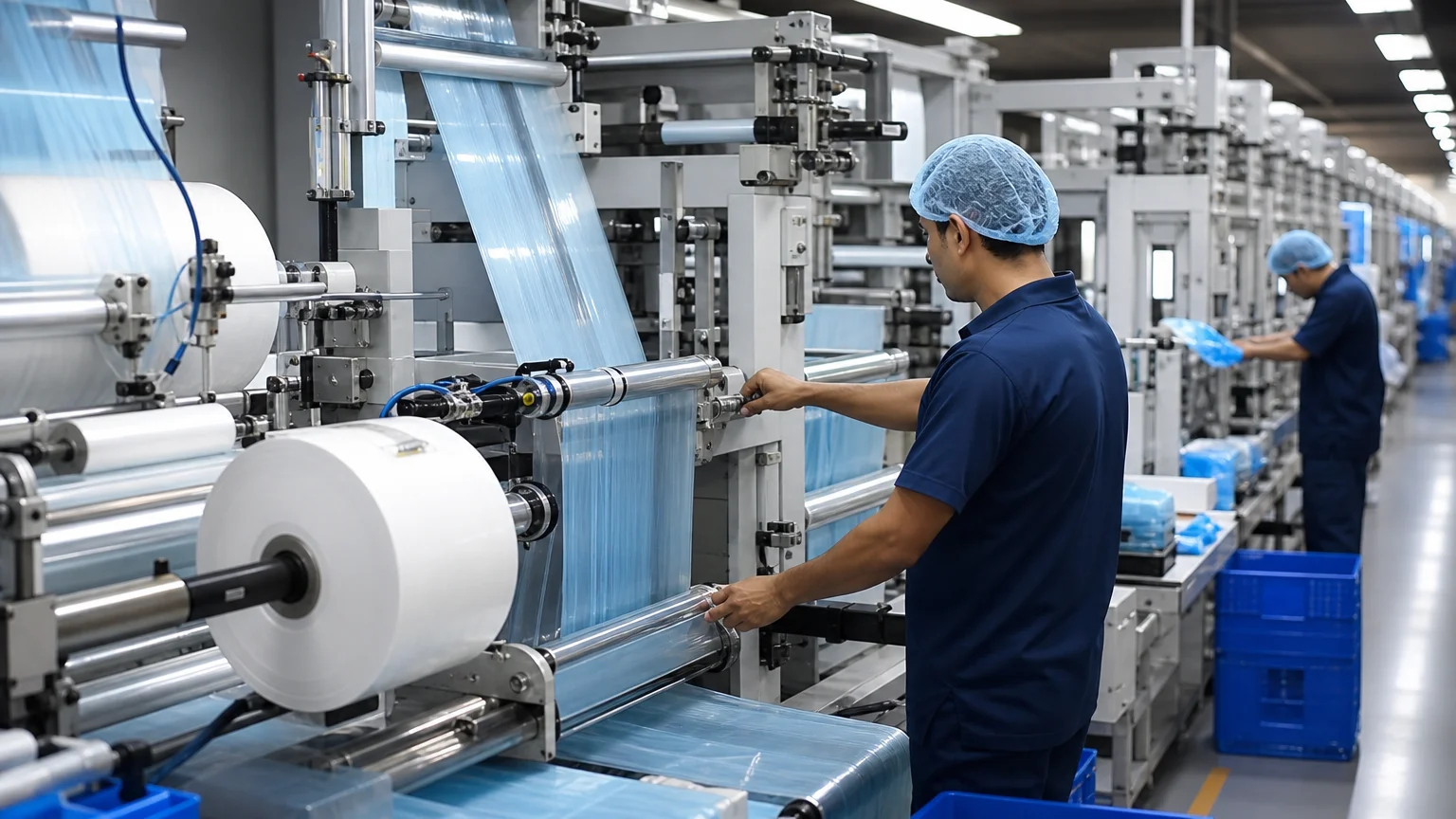
Ask for monthly capacity in tons and daily output, then check whether the figure is the whole factory or one line. A factory running 350 tons per month with 20 tons per day across automated lines can absorb a spike order without delaying your repeat program. A trading company quoting the same number may have no line at all.
Request a live factory video or a third-party audit report. Capacity claims without proof tend to collapse under peak season demand.
2. Compliance Documents You Can Verify
Ask for named documents with an issuer, number, validity, scope, and target product. Separate factory-system evidence from product-level testing.
Be careful with food-contact wording. BRCGS Consumer Products and ISO 9001 are quality management system certifications. They do not equal a product-level food-contact migration test. If you need market-specific food-contact documentation under FDA 21 CFR or EU No. 10/2011, request the underlying test report, not just the factory certificate.
3. Clean Production Environment
Disposable gloves are sensitive to contamination. A factory with a Class 100,000 clean workshop controls particles and dust during production, which matters for medical, food, and lab buyers. Ask which products run inside the clean room and ask for the clean workshop test report. Without a controlled environment, even good compound gets contaminated during forming.
4. MOQ That Fits Your Stage
Confirm the minimum order per SKU, color, size, and packaging format. Ask whether a first order and a repeat order use the same threshold, and whether artwork, tooling, or mixed cartons change the MOQ.
5. Sample-to-Bulk Process
Ask what the sample includes and when the bulk lead-time clock starts. The approved sample should lock material, thickness, color, embossing, packaging, and label artwork before deposit or production approval.
6. OEM, Private Label, and Export Support
Check whether the factory can print your box, apply multilingual labels, and handle country-of-origin marking. Export experience across 100+ countries means the team has seen your destination's labeling rules before. If you plan to build a branded line, review private label disposable gloves to see what packaging customization a capable partner should offer.
OEM Manufacturer Capability at a Glance
The table below maps each buyer concern to the document or number that answers it. Use it as a quick screen before you go deeper with any supplier.
| Buyer concern | What to ask the OEM manufacturer | What a capable answer looks like |
|---|---|---|
| Can it handle my volume? | Monthly capacity in tons, plus daily output | 350 tons/month, 20 tons/day on automated lines |
| Is the factory audited? | BRCGS and ISO 9001 certificate numbers; amfori BSCI monitoring ID | BRCGS CP No. CN-BRCCP-251634; ISO 9001 No. 77067/A/0001/UK/En; BSCI Monitoring ID 25-0331657 |
| Is production clean? | Clean workshop class and test report | Class 100,000 clean workshop, third-party test report |
| Can I start small? | MOQ per SKU | USD 3,000 per SKU, supports small reorders |
| How fast is turnaround? | Sample lead time and bulk lead time | ~7 days samples; 20–30 days bulk after deposit |
| Is quality traceable? | Defect rate and batch retention policy | Under 0.1% defect rate (published reference; scope to be confirmed), retained samples per batch |
Samples, MOQ, and Lead Time: What to Negotiate
Three numbers decide whether a glove OEM project is viable for your business: the sample timeline, the MOQ, and the bulk lead time. Negotiate these before you commit, because they constrain cash flow and shelf-stocking for the whole program.
Sample timeline. Aim for samples in about 7 days. A factory that takes three weeks to cut a sample will struggle with your production schedule. Use the sample to lock the material, thickness, color, and embossing before any bulk order.
The Compliance Document Checklist for an OEM Glove Order
Before you place a bulk order, request a document package from the OEM manufacturer. These files are what your customs broker, retail buyer, and regulator will ask for — get them up front, not after the container ships.
- BRCGS Consumer Products Certificate (No. CN-BRCCP-251634; valid to 2026-12-22) — factory audit
- ISO 9001 Certificate (No. 77067/A/0001/UK/En; valid to 2028-07-25) — quality management system
- amfori BSCI Monitoring Summary (Monitoring ID 25-0331657; valid to 2027-07-16) — social-compliance monitoring report, not a certificate
- REACH inspection report — for EU-bound PE products
- Food-contact test report — request the specific migration test for your target market (FDA 21 CFR or EU No. 10/2011); this is separate from the factory certificate
- Batch traceability records — retained samples and lot-to-compound mapping
One trap to avoid: do not accept a factory certificate as proof of product compliance. A factory certificate proves the system. A migration test report proves the product. If a supplier cannot tell the difference, treat it as a warning sign. For the full supplier qualification checklist approach, see food safe gloves supplier guide, which breaks down the same logic for food buyers.

Worldchamp Manufacturing Context for OEM Glove Buyers
Worldchamp supports PE, CPE, TPE, HDPE, LDPE, and POE glove programs from a Huizhou manufacturing operation. The published profile describes a 12,000 m² full-process factory, automated lines, and a Class 100,000 clean workshop.
Use these figures as capability context, then confirm the proposed SKU, current capacity, packaging plan, documents, and batch traceability in writing. Factory certificates support supplier qualification but do not replace product-specific tests.
Procurement Action Checklist
- Define your spec first — pin down material, size, thickness, color, and packaging before you contact a factory.
- Screen on capacity and certifications — ask for tonnage, daily output, and verifiable certificate numbers.
- Confirm traceability — retained samples and batch-to-compound records protect you on claims and recalls.
Frequently Asked Questions
What is a disposable gloves OEM manufacturer?
A disposable gloves OEM manufacturer produces gloves to your specification — material, size, thickness, color, and packaging — and packs them under your brand. You bring the design and the factory runs the compound, film blowing, cutting, and bagging. This differs from buying ready stock or from ODM, where the factory supplies its own proven design.
What MOQ should I expect from a disposable gloves OEM manufacturer?
The published starting threshold is USD 3,000 per SKU. The actual MOQ can change with material, dimensions, packaging, printed artwork, order mix, and current factory capacity, so obtain written sales confirmation before ordering.
What compliance documents should I request from a glove OEM manufacturer?
Request the current ISO 9001 and BRCGS factory-system certificates, then request product- and market-specific evidence for the proposed SKU, such as the applicable food-contact migration or material test report. Verify the holder, scope, validity, product identity, and target market instead of treating a factory certificate as product approval.
How long do samples and bulk orders take?
Pre-production sample timing is approximately seven days as a reference. Confirm the current sample and bulk-production schedule after the specification, packaging, artwork, and sample are approved, and state in writing whether the schedule starts from deposit, sample approval, or final artwork approval.
Is a factory BRCGS certificate the same as food-contact compliance?
No. BRCGS Consumer Products and ISO 9001 certify the factory quality management system, not the product food-contact safety. Food-contact compliance rests on a product-level migration test report under FDA 21 CFR or EU No. 10/2011. Request the underlying test report for your target market.
Put this guide into a procurement workflow
When the product direction is clear, review the OEM and ODM workflow, plan a custom compostable bag program, review the low-MOQ sourcing route, and discuss the specification with Worldchamp. Share the task, destination, quantity, packaging and evidence requirements so the next review is specific.
Turn the comparison into a sample and document brief
Share the application, market, quantity, pack format and scope of supporting documents. Worldchamp can then respond against a defined product rather than a generic material request.