Client Background
The client is a Japanese medical protective wear procurement team — referred to here as a medical supply buyer — sourcing disposable protective products for healthcare and clinical settings. Like many buyers in this segment, their requirement was not simply finding a cheaper supplier. They needed a vendor who could deliver consistent product quality across repeated orders and maintain a reliable shipment schedule to support ongoing inventory planning.
Their core product in this engagement was a disposable PE apron for medical protection use — a category that, while often treated as low-value, directly affects clinical staff comfort, waste management costs, and procurement confidence when quality varies between batches.
The Challenge: Supply Consistency Was the Real Problem
Before working with Worldchamp, this buyer had encountered two recurring pain points with their existing PE apron supply chain.
The first was supply rhythm instability. Shipments arrived without a predictable cadence, which complicated inventory management and required larger safety stock — adding cost and administrative burden.
The second was film thickness inconsistency. When thickness varies between batches, the feel and perceived reliability of the product changes, which can generate complaints from end users and raise questions about sourcing quality.
Together, these two problems — neither of which would show up in a single sample evaluation — made it difficult to treat PE apron procurement as a solved problem, even after initial supplier qualification.
- Unpredictable delivery schedules increased safety stock requirements and procurement overhead.
- Film thickness variance affected end-user experience and raised the risk of complaint escalation.
- No batch-level consistency controls meant quality could differ from one order to the next without early warning.
Our Solution: Custom PE Apron Supply Managed for Consistency
Worldchamp approached this project not as a standard product inquiry, but as a supply stability program. The starting point was aligning the production workflow to the buyer's actual use case — medical protection environments where apron performance and predictable replenishment both matter.
The solution addressed three interconnected layers:
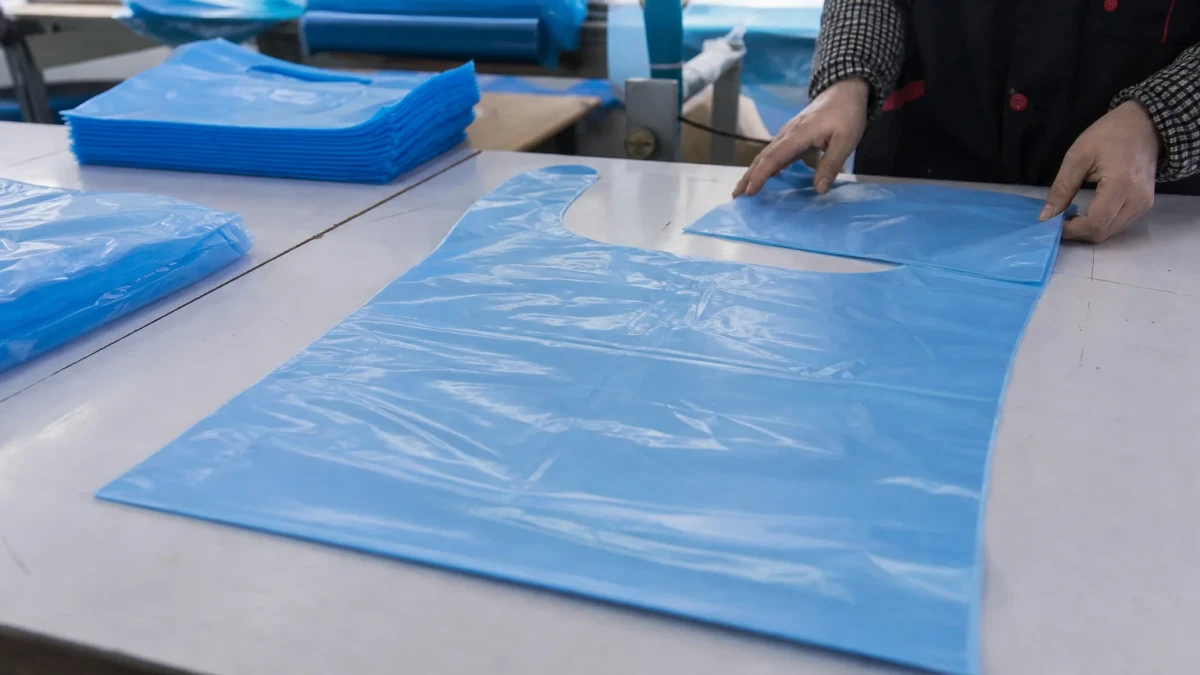
1. Raw Material Compound Optimization
The project team adjusted the PE film compound formulation to improve batch-to-batch stability. The goal was not simply to meet a target thickness spec on a single sample, but to reduce variability in film behavior across production runs.
2. Blown Film and Cutting Process Controls
During protective wear manufacturing, blown film uniformity and cutting precision are the two process stages that most directly determine whether thickness and edge quality are reproducible. Worldchamp implemented tighter in-process checkpoints at both stages.
3. Production Scheduling Lock-In
To address delivery inconsistency, the supply team coordinated production scheduling specifically around the buyer's order cadence. Key production windows were locked in advance to reduce delay risk caused by scheduling conflicts or capacity fluctuations.
This approach shifted risk management upstream — into the vendor's production process — rather than leaving the buyer to absorb uncertainty through safety stock and expedited shipping.
Implementation: Batch-Level Stability Over Single-Sample Qualification
After confirming specifications and use requirements, Worldchamp aligned the PE apron production parameters with the buyer's medical protection application. The implementation covered raw material preparation, blown film, cutting, batch inspection, and packaging — each treated as a controlled handoff point rather than an independent operation.
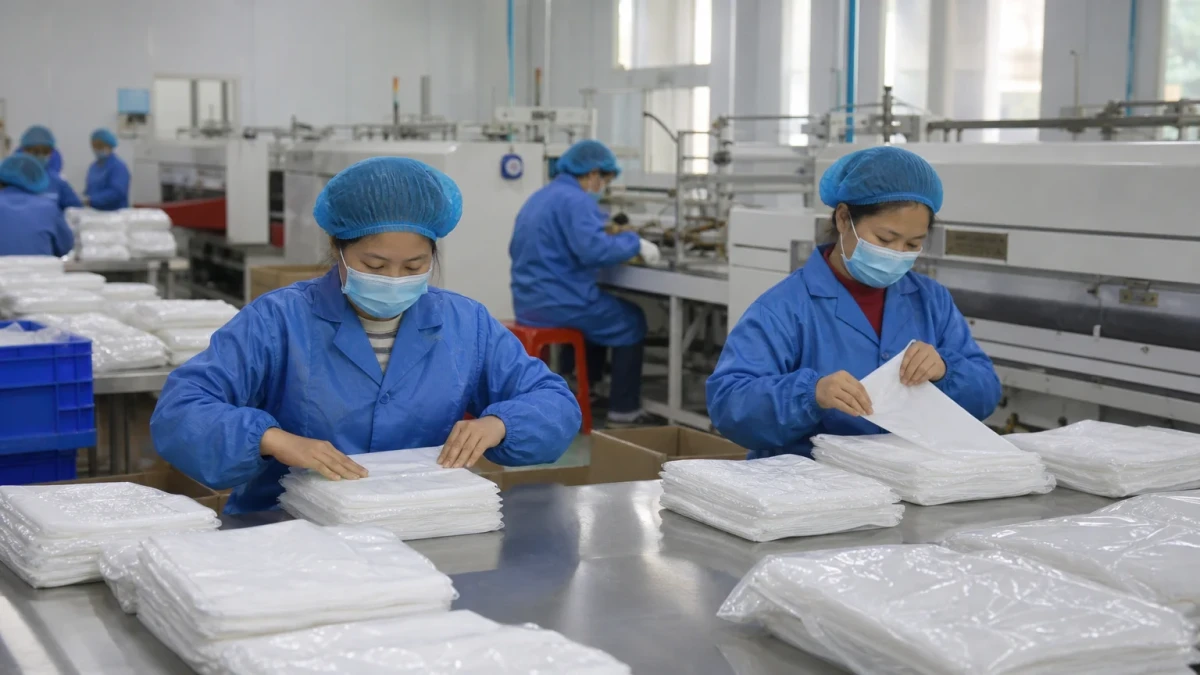
A key differentiator was the emphasis on batch stability over sample approval. The underlying problem was not that a single apron sample failed inspection — it was that quality and delivery varied across replenishment cycles.
Before shipment, products were organized and packaged by batch to support downstream inventory management, distribution, and repeat order tracking. Packaging format and labeling were aligned with the buyer's requirements for the Japanese market.
Results
- Reduced batch-to-batch thickness variance: Compound formulation and blown film controls lowered variability between production runs.
- Improved delivery reliability: Locked production scheduling eliminated the supply rhythm gaps that had previously forced the buyer to hold excess safety stock.
- Fewer defect-related complaints: Lower tear and defect incidence reduced the downstream complaint burden on the buyer's distribution team.
“Product quality has been stable and delivery has been reliable — very much in line with what we need.”Procurement Manager, Japanese Medical Protective Wear Buyer
What This Case Means for Similar Buyers
A single sample evaluation cannot reveal whether a supplier can maintain quality across replenishment cycles. Film thickness uniformity, cutting consistency, batch inspection rigor, and production scheduling discipline are all invisible until they break down.
If you source disposable protective aprons for medical protection, clinical hygiene, or industrial use, ask how inter-batch film variance is controlled, what in-process checkpoints cover blown film and cutting, and how production scheduling is managed for repeat orders.
These questions surface whether a supplier treats your account as a managed supply program or as a series of independent transactions.
Related Products & Pages
FAQ
1. Can Worldchamp produce custom disposable PE aprons for medical protection use?
Yes. Worldchamp supports custom PE apron production based on target dimensions, film thickness preferences, material performance requirements, packaging format, and application-specific needs.
2. How does Worldchamp reduce film thickness variance in PE aprons?
Production controls address raw material compound formulation, blown film process parameters, cutting stability, and batch-level inspection. Target thickness ranges should be confirmed during sample review and before volume production.
3. Can Worldchamp provide export or quality documentation for PE apron orders?
Worldchamp can provide applicable documentation when required, including certificates of analysis, conformity declarations, certificates of origin, and other export documentation. The exact list should be confirmed before production.
4. What are typical lead times for samples and bulk orders?
Samples are typically available in approximately 7 days. Bulk orders typically ship within 20–30 days after deposit and final specification confirmation.
5. Does Worldchamp support export-grade packaging for PE apron orders?
Yes. Inner bag count, carton configuration, labeling, palletization, and destination requirements should be confirmed before production.
Need reliable custom PE apron supply?
Share target dimensions, film thickness, packaging format and order cadence for sample review.
Discuss the apron program