What Makes a Glove Truly Compostable? (The Short Answer)
A glove is only compostable if it breaks down completely in a certified composting facility — leaving no toxic residue — within a defined timeframe. The two benchmark standards are ASTM D6400 (used in North America) and EN 13432 (used in Europe). Both require the material to disintegrate at least 90% within 180 days under industrial composting conditions.
That sounds simple. But the phrase "compostable gloves" now covers at least three very different material routes: PLA-based, PLA+PBAT blended, and additive-modified plastics marketed as biodegradable. Each one performs differently in real composting facilities — and behaves very differently on a glove production line.
E-E-A-T note: Worldchamp holds three independent compostable certifications for its glove products: DIN CERTCO Certificate No. 9G0275 (industrial composting), SEEDLING Certificate No. 7P1218 (industrial + home composting), and BPI Certificate No. 10529018-3 (North American market). All three apply specifically to gloves, not bag products.
Material Route 1 — PLA (Polylactic Acid): Renewable but Heat-Sensitive
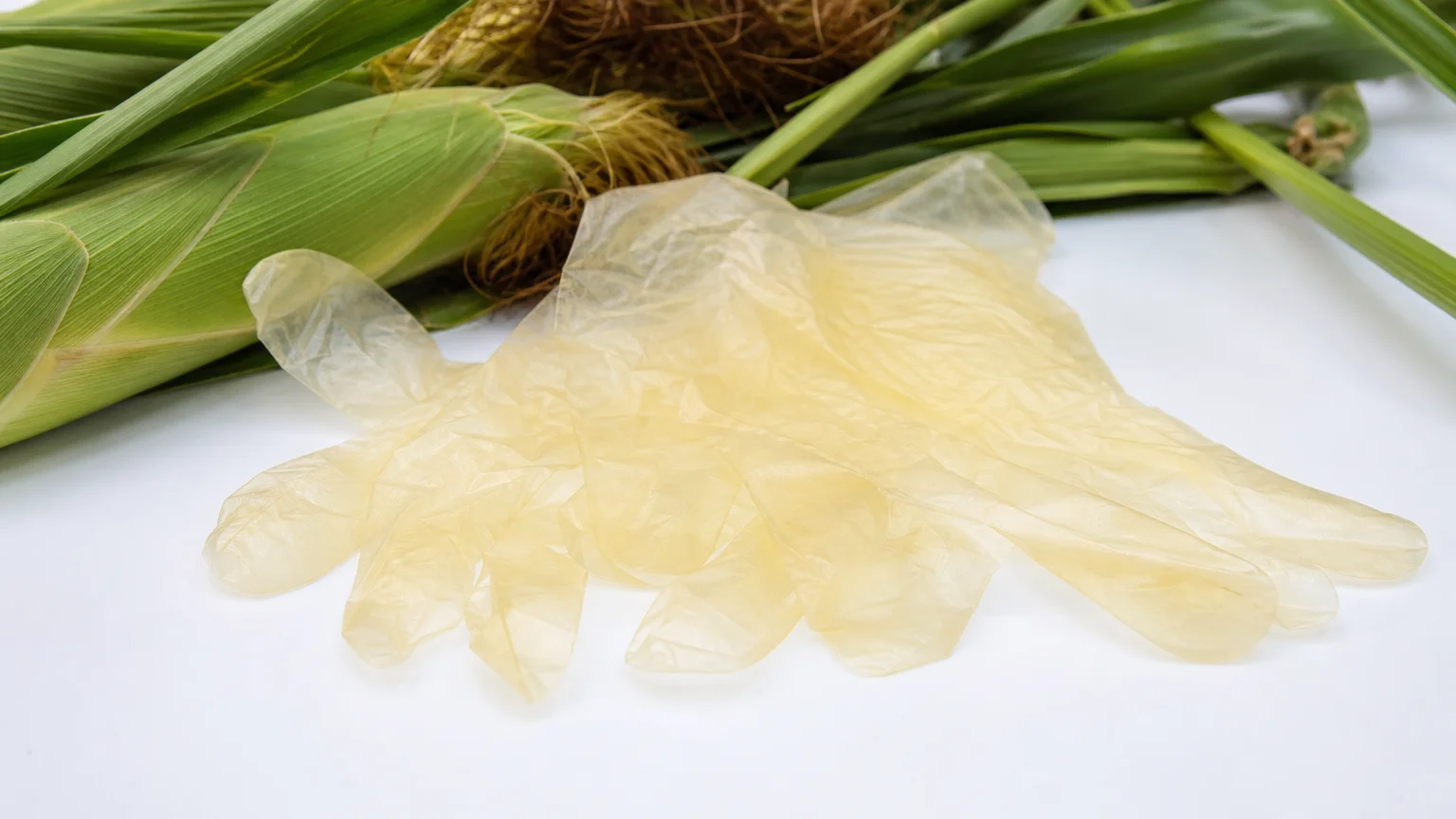
PLA is made from fermented plant sugars — typically corn starch or sugarcane. It is a biobased polymer, meaning the carbon in PLA comes from plants grown in the current season, not from ancient fossil fuels. That makes its lifecycle carbon story compelling.
Pure PLA films are rigid and clear. Glove manufacturers using PLA need to process it thin enough to stay flexible. That creates two performance limits buyers rarely hear about.
The Temperature Problem
PLA softens at temperatures above 50°C (122°F). This is a low threshold for a disposable product. A glove sitting in a warehouse in a hot climate, or stored near ovens in a food processing plant, can deform. For buyers in the Middle East or Southern US, this is a genuine sourcing risk — not a theoretical one.
The Shelf Life Problem
PLA starts to hydrolyze slowly even in ambient humidity. Shelf life for pure PLA gloves is typically 10 to 12 months under controlled storage conditions. Nitrile and PE gloves routinely carry three to five year shelf lives. If your distribution chain stores product for longer than a year, pure PLA creates inventory risk.
The Composting Condition Problem
Here is what most PLA marketing omits: PLA requires industrial composting to break down properly. Industrial facilities maintain temperatures of 55–60°C and high microbial activity. In a home compost bin — or worse, in a landfill — PLA degrades extremely slowly, sometimes over decades. The SEEDLING certification from European Bioplastics covers both industrial and home composting. A standalone ASTM D6400 certification only confirms industrial composting performance. Buyers selling into municipal compost programs should check which standard applies.
Material Route 2 — PLA + PBAT Blend: Better Flexibility, Longer Shelf Life
PBAT stands for polybutylene adipate co-terephthalate. It is a petroleum-derived polymer — which means it is not biobased — but it is certified compostable under both ASTM D6400 and EN 13432. PBAT is soft, flexible, and much more elastic than pure PLA.
Blending PLA with PBAT (typically a 60/40 to 70/30 PLA/PBAT ratio) produces a film that captures the biobased carbon content of PLA while fixing PLA's brittleness with PBAT's elasticity. This is the material behind most commercial-grade compostable gloves today — including Ansell's MICROFLEX 31-103, which Ansell's own product literature describes as a "PLA blend" combining PLA and PBAT.
The Trade-Offs of PLA+PBAT
Adding PBAT does extend shelf life compared to pure PLA, and it raises the heat tolerance slightly. But two realities remain. First, the PBAT fraction is petroleum-derived, so the product cannot claim to be "100% plant-based." Second, industrial composting is still required — a PLA+PBAT blend does not home compost reliably. Buyers marketing to environmentally-aware consumers should be precise about these distinctions to avoid greenwashing claims.
Cost is also a factor. PLA+PBAT blended film costs significantly more than standard PE or CPE film. For high-volume food service buyers, the premium can reach 40–80% over conventional disposable gloves, depending on order size and market conditions.
"Biodegradable" Additives: What That Label Often Misses
A third category uses conventional PE or similar fossil-fuel plastics combined with pro-degradant additives — oxo-degradable or d2w-type chemistries. These products are sometimes sold under "biodegradable" labeling in markets where the term is less regulated.
Here is the critical difference: additive-modified PE is not the same as compostable. Oxo-degradable plastics fragment into smaller pieces under heat and UV exposure. They do not meet ASTM D6400 or EN 13432 standards. The European Union explicitly prohibited oxo-degradable plastics in single-use plastic regulation (EU) 2019/904 effective July 2021, citing concerns that fragmentation creates microplastic pollution rather than true biodegradation.
If you are sourcing for markets with regulatory requirements — EU, California, or buyers with zero-microplastic commitments — confirm that your supplier holds an actual third-party composting certification, not just a biodegradable additive formula sheet. The certification number should be verifiable on the issuing body's public registry (DIN CERTCO, BPI, TUV Austria).
POE Gloves and Compostability: An Honest Answer
POE (polyolefin elastomer) gloves are made from a petroleum-derived thermoplastic elastomer. POE is not compostable under ASTM D6400 or EN 13432. This is a straightforward fact, and suppliers selling POE gloves as compostable would be making an incorrect claim.
So why include POE in a compostable glove materials guide?
Because buyers sourcing for sustainability often compare their options across the full range of disposable gloves — and POE deserves an honest position in that comparison. POE gloves are recyclable through polyolefin recycling streams in markets where such infrastructure exists. They are also latex-free, produce no chemical by-products during manufacturing that exceed REACH thresholds, and meet food contact compliance requirements applicable to their material category. For the full technical positioning of POE as a material family, see our POE material innovation overview.
Worldchamp pioneered POE gloves in 2024 as an industry first. Our POE line is positioned as a durable, cost-stable alternative to nitrile — not as a compostable product. For buyers whose sustainability requirements center on certified compostability with third-party verification, the correct Worldchamp product is our certified compostable biodegradable glove, which holds DIN CERTCO, SEEDLING, and BPI certification. See our compostable glove biocompounds page for compound specification details. If you are comparing POE against nitrile as sustainability alternatives, our POE vs nitrile glove materials guide covers cost, barrier performance, and compliance positioning side by side.

Compostable Glove Materials Compared (Side-by-Side Table)
| Material Route | Composting Condition | Temperature Limit | Shelf Life | Key Certification | Who It Fits |
|---|---|---|---|---|---|
| Pure PLA | Industrial only | <50°C / 122°F | 10–12 months | ASTM D6400, EN 13432 | Short-chain retail, cooler climates |
| PLA + PBAT Blend | Industrial only | <55°C / 131°F | 12–18 months | ASTM D6400, EN 13432, BPI, DIN CERTCO | Food service, healthcare, OEM buyers |
| Additive-Modified PE | Not certified compostable | Standard PE range | 2–3 years | None (not ASTM D6400 / EN 13432) | Markets without compostability regulation |
| POE (Polyolefin Elastomer) | Not compostable — recyclable | Standard polyolefin range | 3+ years | REACH, food contact compliance | Buyers prioritizing durability + cost stability |
What to Ask Before You Order
Certifications protect you. Supplier claims do not. Before placing a compostable glove order, confirm the following five points in writing:
- Ask for the certificate number — not a generic logo. Every DIN CERTCO, BPI, and SEEDLING certificate has a verifiable registration number you can check on the certifier's public database.
- Confirm the certified product matches what you are buying — a certificate covering one SKU does not automatically cover a new thickness, color, or production batch.
- Clarify whether the certification covers industrial composting only, or also home composting — this changes what you can print on retail packaging.
- Ask for shelf life data — get the supplier's recommended storage temperature and humidity range in writing, with a stated shelf life period.
- Request migration test documentation if the gloves will contact food — composting certification does not automatically mean food contact compliance. These are separate regulatory frameworks.
Our guide on compostable glove certification covers DIN CERTCO, BPI, SEEDLING, and TUV Austria marks in detail, including what each certificate scope actually covers and how to cross-check supplier claims. You can also verify Worldchamp's own certificates directly on our certifications page, where the certificate numbers and issuing body documentation are listed.
Worldchamp's Compostable Glove Manufacturing
Worldchamp has held compostable glove certifications since 2021. Our certified compostable glove products hold all three major marks simultaneously: DIN CERTCO No. 9G0275, SEEDLING No. 7P1218, and BPI No. 10529018-3. These certifications cover our glove products specifically — not our bag line, which holds a separate biodegradable inspection report (Report No. WT20103211073930WT1, Shenzhen Academy of Metrology and Quality Inspection, CNAS-accredited).
Our production facility in Huizhou, Guangdong runs 20 tons per day and holds BRCGS Consumer Products Certificate No. CN-BRCCP-251634 and ISO 9001 Certificate No. 77067/A/0001/UK/En. Our minimum order starts at USD 3,000, with samples dispatched within 7 days and bulk orders delivered in 20–30 days after deposit.
For eco-sourcing buyers who need certified compostable gloves with traceable certification numbers, request samples through our eco-friendly disposable products page or contact us directly. For buyers in the food service sector evaluating compostable options against conventional PE or TPE, our materials team can provide a comparison data sheet covering composting standards, food contact compliance status, and cost per 1,000 gloves.
Need Certified Compostable Gloves With Traceable Certification Numbers?
Tell us your target market, composting standard (ASTM D6400, EN 13432, or home compost), and annual volume. We will send samples with full certification documentation and a cost comparison within 7 days.
Frequently Asked Questions
Is PLA the same as compostable?
PLA (polylactic acid) is a biobased polymer that can be certified compostable under ASTM D6400 or EN 13432 — but only in industrial composting conditions. PLA does not break down reliably in home compost bins or landfills. A product made from PLA must still carry a valid composting certification to make a verified compostable claim.
What is the difference between biodegradable and compostable gloves?
Biodegradable means a material can be broken down by microorganisms eventually — but the term has no standardized timeframe or condition. Compostable is a regulated claim: a compostable product must meet specific disintegration rates under defined temperature and moisture conditions, verified by a third-party certification body like BPI, DIN CERTCO, or TUV Austria. Not all biodegradable products are compostable. Not all compostable products are home-compostable.
Can compostable gloves be used for food handling?
Yes, but composting certification and food contact compliance are separate regulatory frameworks. Compostable certification confirms the material breaks down in a composting facility. Food contact compliance (FDA 21 CFR, EU No. 10/2011) confirms the material does not transfer harmful substances to food. You need both certifications if the gloves will be used in food handling. Ask your supplier for migration test documentation separately.
Why do compostable gloves have a shorter shelf life?
PLA and PLA+PBAT blended materials begin to hydrolyze slowly when exposed to moisture over time. This is part of the same mechanism that allows them to biodegrade in composting conditions. Most certified compostable gloves carry a recommended shelf life of 10 to 18 months, depending on the specific formulation and storage conditions. Conventional PE or nitrile gloves typically last 3 to 5 years. Factor this into your inventory planning before committing to large volumes.
Are POE gloves eco-friendly?
POE gloves are not certified compostable. They are made from petroleum-derived polyolefin elastomer. However, POE is recyclable through polyolefin recycling streams where that infrastructure exists. They are also latex-free, REACH-compliant, and do not require the specialized industrial composting facilities that PLA or PLA+PBAT blends need at end of life. Whether POE qualifies as "eco-friendly" depends on your specific sustainability framework and how your market defines the term.