Are TPE Gloves Food Safe? — The Short Answer
Yes — TPE gloves are food-safe when the manufacturer has run a third-party food contact migration test. TPE (thermoplastic elastomer) is a latex-free, BPA-free polymer with no known allergens. That covers the material side. But food safety compliance also depends on testing, not just material.
The right question for a food buyer is not only "Is the material safe?" It is also "Can the supplier provide a test report proving it?" That distinction matters — especially when you need documentation for a retail buyer, food safety auditor, or market regulator.
About this guide: Worldchamp operates a Class 100,000 clean workshop in Huizhou, China, certified under BRCGS Consumer Products Certificate No. CN-BRCCP-251634 and ISO 9001 Certificate No. 77067/A/0001/UK/En. Our TPE gloves carry an SGS Food Contact Test Report and a California Proposition 65 Test Report — two documents most TPE glove suppliers cannot provide.
What Makes a Glove Food-Contact Safe: The Two-Layer Compliance Framework
Many buyers assume a factory certification equals product food-contact compliance. It does not. These are two separate layers.
Layer 1 — Factory quality certification confirms that the facility runs a controlled production system. BRCGS Consumer Products and ISO 9001 are factory-level standards. They confirm how gloves are made, not whether the glove polymer migrates harmful substances into food.
Layer 2 — Product migration testing tests whether the actual glove, under real conditions (time, temperature, food simulants), releases any substance above the regulatory limit. This is what FDA 21 CFR and EU No. 10/2011 govern.
| Document type | What it confirms | Required for food contact claim? |
|---|---|---|
| BRCGS Consumer Products certificate | Factory quality management system | No — factory-level only |
| ISO 9001 certificate | Factory quality management system | No — factory-level only |
| SGS Food Contact Test Report | Product migration compliance (FDA 21 CFR / EU framework) | Yes — product-level proof |
| California Prop 65 Test Report | No listed chemicals above safe harbor limits | Yes — required for US California market |
When you evaluate a TPE glove supplier, ask for both layers. A supplier with only factory certs and no migration test report cannot make a defensible food-contact compliance claim.
TPE Gloves and FDA 21 CFR: What the Regulation Actually Requires
In the United States, food contact materials are governed by FDA 21 CFR Part 177 — the section covering polymers used in food contact articles. For TPE gloves, the relevant sub-section is typically 21 CFR 177.2600 (rubber articles intended for repeated use) or 21 CFR 177.1520 (olefin polymers), depending on the exact TPE compound.
The regulation sets specific migration limits (SML) — the maximum amount of a substance that can migrate from the glove into food. A certified migration test, run by an accredited lab like SGS or Eurofins, measures whether the actual glove product stays under those limits.
Key point for buyers: FDA does not approve or certify individual glove products. Compliance is demonstrated by a valid, product-specific migration test report — not by a factory operating in the US or having FDA registration.
What "FDA Compliant" Actually Means
When a supplier says their TPE gloves are "FDA compliant," that phrase means the gloves have been tested and confirmed to meet the composition and migration requirements under FDA 21 CFR. It does not mean the FDA has reviewed or stamped that specific product.
Always ask for the actual test report, not just the claim. The report should name the glove product, list the simulants used, show the measured migration values, and confirm they are below the SML thresholds.
EU No. 10/2011 and Migration Testing for TPE Gloves
For European market buyers, the relevant standard is EU Regulation No. 10/2011 on plastic materials intended for food contact. It sets overall migration limits (OML) of 10 mg/dm² and specific migration limits (SML) for listed substances.
TPE falls under the plastics framework, so a migration test run against EU 10/2011 food simulants (aqueous, acidic, alcoholic, fatty) confirms whether the glove is compliant for EU food handling use. The test protocol and simulant selection depend on the food types the glove will contact.
Buyers sourcing TPE gloves for EU retailers or food processors should request a test report that explicitly references EU 10/2011 or ask the supplier which food simulants were used. A US-only FDA 21 CFR test report may not fully satisfy EU requirements, depending on the simulant set.
The Documents to Request: A B2B Compliance Checklist
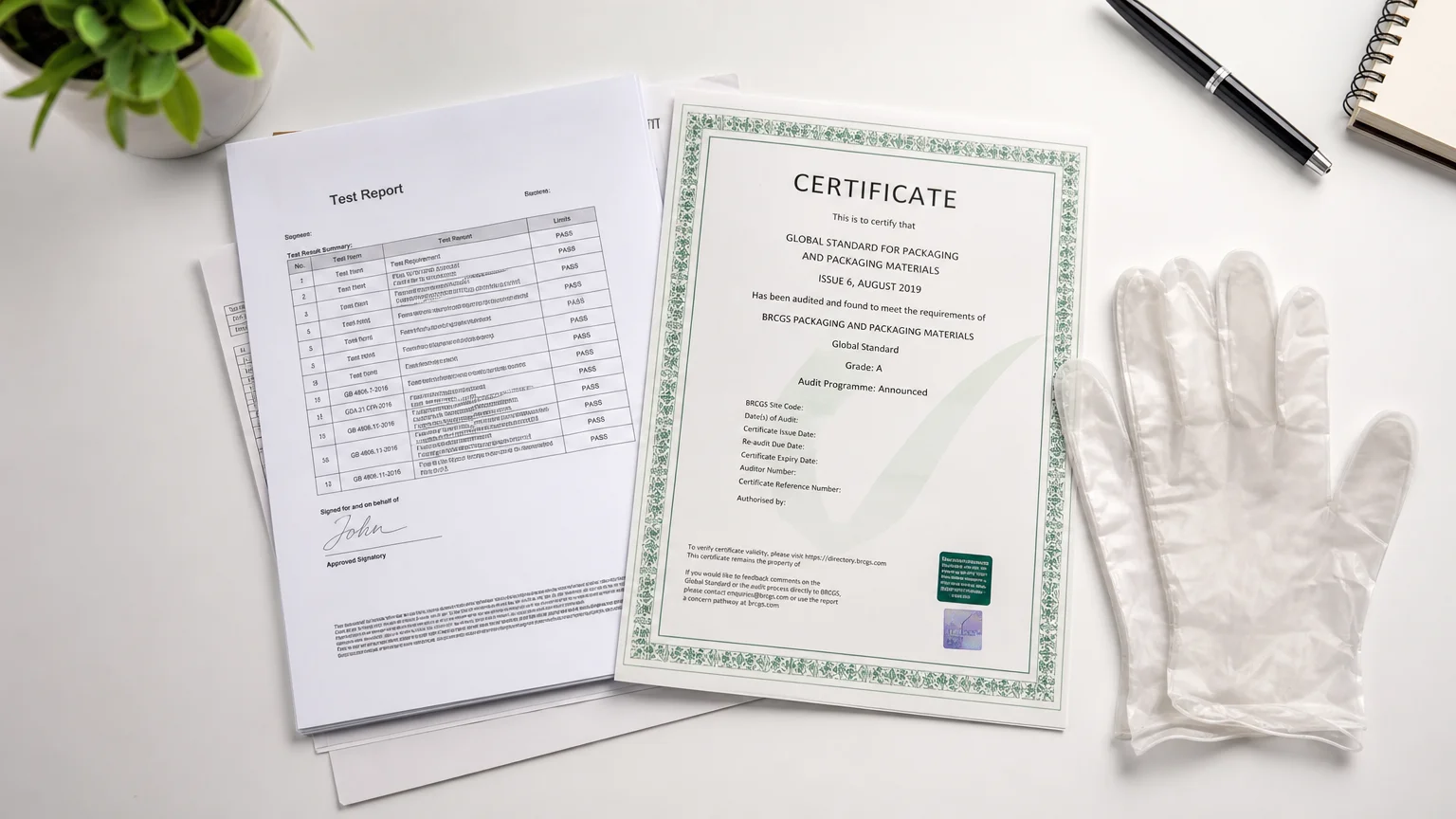
Here is a practical checklist for food buyers evaluating a TPE glove supplier. Request these before placing a bulk order.
Mandatory — Product-Level Documents
- Food contact migration test report (SGS, Eurofins, Bureau Veritas, or equivalent accredited lab) — must name the specific glove product, list migration test values, reference FDA 21 CFR or EU No. 10/2011
- California Prop 65 test report — required if you sell to the California market; confirms no listed substances above safe harbor levels
Supporting — Factory-Level Documents
- BRCGS Consumer Products certificate (not BRC Food — these are different standards) — confirms the factory runs a quality-managed production system for consumer goods including disposable gloves
- ISO 9001 certificate — quality management system
- BSCI audit report — social compliance, required by many European retail chains
Useful for Traceability
- Batch-level retained samples — ask how long the supplier keeps production samples for each batch
- Country of origin documentation — required for customs and tariff classification
A supplier who cannot provide the product-level migration test report is not in a position to make a documented food-contact compliance claim — regardless of how many factory certificates they hold.
Worldchamp TPE Gloves: What We Can Provide

Worldchamp has manufactured disposable gloves since 1997. Our TPE gloves are produced in a Class 100,000 clean workshop at our 12,000 m² facility in Huizhou, Guangdong, China. Our defect rate is below 0.1%, validated by in-line quality checks and retained batch samples.
For food buyers, we can provide:
- SGS Food Contact Test Report — product-specific, run against the FDA 21 CFR framework. This is available for our TPE gloves specifically; it does not cover our PE or CPE lines.
- California Proposition 65 Test Report — for US buyers targeting the California market
- BRCGS Consumer Products Certificate No. CN-BRCCP-251634 — factory quality management certification covering manufacturing of PE glove / apron / sleeve / bag. Valid through December 2026.
- ISO 9001 Certificate No. 77067/A/0001/UK/En — quality management system, full facility scope
- BSCI Summary Audit Report — social compliance, for EU retail supply chains
Our production capacity is 20 tonnes per day / 350 tonnes per month, with a minimum order of USD 3,000 and a sample lead time of 7 days. Bulk lead time is 20–30 days from sample confirmation.
We have supplied food handling customers across the US, EU, and Middle East, including food distributors and food processing facilities. Documentation packages can be prepared before a purchase order is issued — contact us with your target market and regulatory framework.
Procurement Action Checklist
- Confirm your market's regulatory framework — FDA 21 CFR for the US, EU No. 10/2011 for Europe, or both if you serve multiple markets.
- Request the migration test report before sampling — a reputable supplier will have it ready. If they cannot produce it, treat that as a red flag.
- Check the test report specifics — it must name your exact glove product, list the simulants used, and show migration values below the SML thresholds. A generic "food safe" statement is not a test report.
- Separate factory certs from product compliance — BRCGS Consumer Products and ISO 9001 confirm factory quality management. They do not replace a migration test report for food contact claims.
Need TPE Glove Compliance Documents for Your Market?
Tell us your target market and regulatory framework (FDA 21 CFR, EU No. 10/2011, or both). We will send the SGS food contact test report, Prop 65 report, and our BRCGS certificate package — before you place an order.
Frequently Asked Questions
Do TPE gloves meet FDA food contact requirements?
TPE gloves can meet FDA 21 CFR requirements when tested by an accredited third-party lab. The test must confirm that migration values are below the limits set in 21 CFR Part 177. Ask the supplier for the actual test report — not just a claim that the gloves are FDA compliant.
What is the difference between a factory BRCGS certificate and food contact compliance?
A BRCGS Consumer Products certificate confirms the factory runs a quality-managed production system. It does not confirm that the glove product has passed a food contact migration test. Food contact compliance is proven by a product-specific migration test report from a lab like SGS or Eurofins — these are two separate layers of documentation.
Are TPE gloves latex-free and BPA-free?
Yes. TPE (thermoplastic elastomer) gloves contain no natural latex and no BPA. They are safe for latex-sensitive workers and meet latex-free policy requirements for food handling environments.
What certification do food-grade TPE gloves need?
There is no single global "food-grade certification" for gloves. Compliance is demonstrated by migration test reports that reference the relevant market standard — FDA 21 CFR for the US, EU No. 10/2011 for Europe. The test must be product-specific and run by an accredited laboratory. A California Prop 65 report is also required if you sell to the California market.
Can I use TPE gloves for all food handling tasks?
TPE gloves are well suited for general food handling: portioning, assembly, light prep, and service tasks with a typical wear time of 30–60 minutes per shift. They are not intended for long exposure to high-fat or high-acid foods, where the migration risk increases with time and temperature. For extended contact with fatty foods, check that the migration test report specifically covers fatty food simulants.