The Short Answer
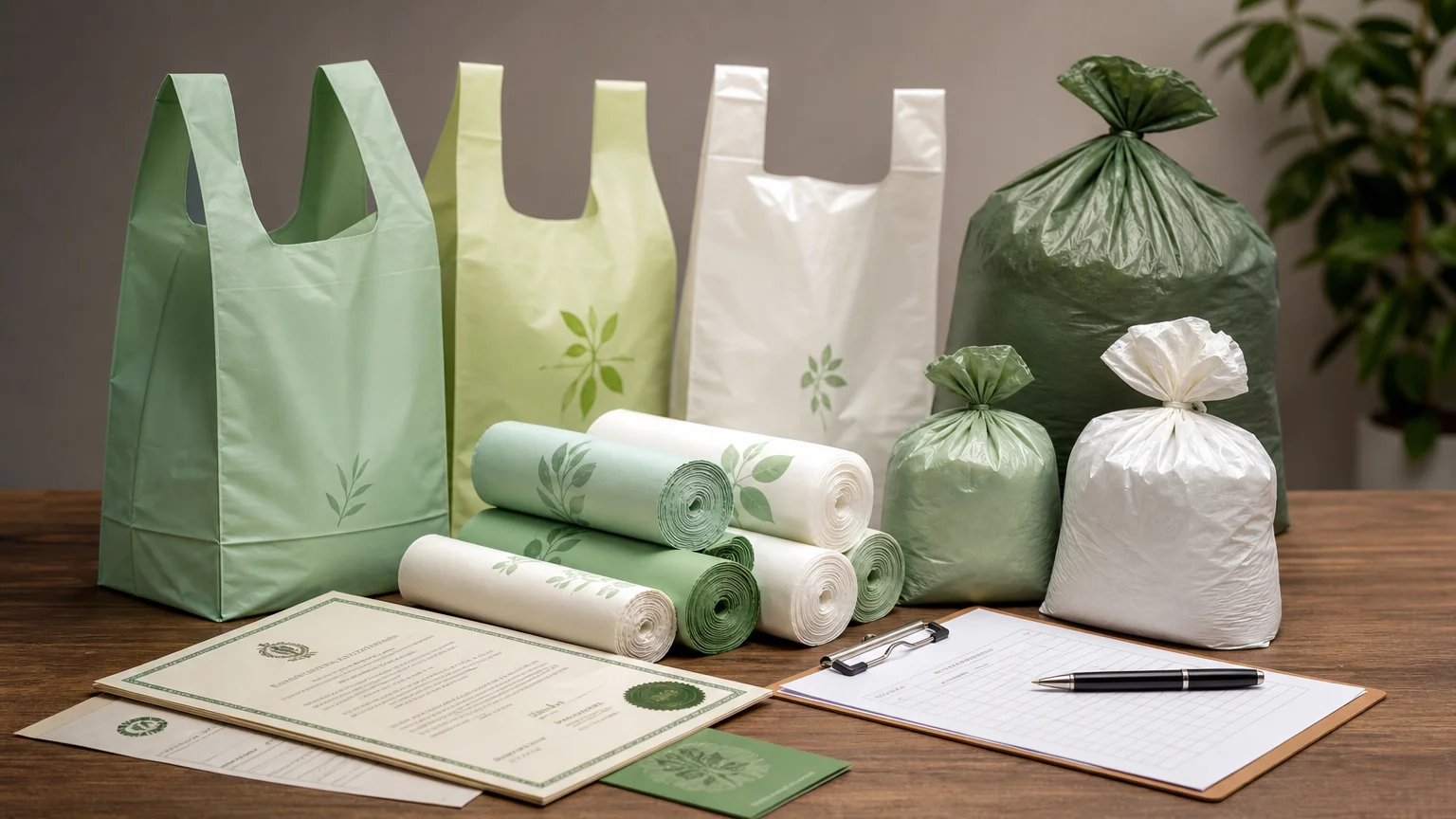
A reliable compostable bags supplier holds verifiable third-party certifications, provides underlying test reports on request, and can demonstrate production capacity that matches your order volume. The biggest risk in this market is not finding a supplier — it is accepting a certification claim that does not cover the product you are actually buying.
About this guide: Worldchamp (HuiZhou) Plastics Products Co., Ltd. manufactures compostable and biodegradable bags with third-party test documentation verified by CNAS-accredited laboratories. Our facility holds BRCGS Consumer Products Certificate No. CN-BRCCP-251634 and ISO 9001 Certificate No. 77067/A/0001/UK/En. This guide reflects our direct sourcing experience on both sides of the transaction.
6 Dimensions to Evaluate Any Compostable Bags Supplier
Most sourcing mistakes happen before the first order is placed. Buyers accept a supplier's certification claim at face value. They get the bags. Then their retail partner or municipality rejects the shipment because the certification does not actually cover the product in their hands.
Use these six dimensions as your evaluation framework. Each one catches a different category of supplier risk.
1. Certification Authenticity
Ask for the certificate number, then verify it yourself in the issuing body's public database. The three main certifications for compostable bags are:
- BPI (Biodegradable Products Institute) — US standard, based on ASTM D6400. Search the BPI certified products database at bpiworld.org.
- DIN CERTCO — German-based, covers EU industrial composting standard EN 13432.
- SEEDLING / TUV Austria OK Compost — European mark, also based on EN 13432. Covers both industrial (OK Compost INDUSTRIAL) and home composting (OK Compost HOME).
Every real certification is searchable. If a supplier says they are certified but cannot provide a certificate number you can look up, treat that as a red flag.
2. Third-Party Test Report vs. Certification
A certification and a test report are different things. Buyers often confuse them — and some suppliers exploit that confusion.
A certification (BPI, DIN CERTCO, SEEDLING) means an independent body has reviewed ongoing production and issued a formal mark. A third-party test report means a lab ran biodegradability tests on a specific batch and issued a report. Test reports are not certifications, but they are valid evidence when reviewed by someone who understands the test method and scope.
Worldchamp's compostable bags carry Biodegradable Plastic Bag Inspection Report No. WT20103211073930WT1, issued by the Shenzhen Academy of Metrology and Quality Inspection (a CNAS-accredited, CMA-certified laboratory). This is a third-party test document — not a product certification — and that is exactly how we represent it. If a supplier describes a test report as a certification, they do not understand their own documentation.
When you evaluate a test report, check: which standard was tested (ASTM D6400, EN 13432, or GB/T 19277), which product type was tested, and the lab's accreditation status (CNAS, A2LA, UKAS, or equivalent).
3. Production Capacity and Lead Time
A supplier that cannot handle your volume will create recurring supply problems. Get specific numbers before you commit. Ask for monthly production capacity, current lead time for your order size, and whether they operate dedicated compostable bag lines or share equipment with non-compostable PE products.
Shared production lines are a cross-contamination risk. Industrial composting facilities and retail buyers increasingly require that compostable bags be produced on equipment dedicated to compostable materials.
Worldchamp operates a 350-ton monthly capacity across dedicated production lines in a Class 100,000 clean workshop in Huizhou, Guangdong. Standard lead time is 20 working days for bulk orders after sample approval.
4. Food Contact Layer Specification
Not all compostable bags are suitable for food contact. Some bags are designed for dry goods, curbside organics collection, or general retail — not for direct food contact. If your application involves food (produce bags, takeout cup bags, deli wraps), you need to ask the supplier specifically about the inner contact layer.
Ask for confirmation of which food contact standard the bag complies with: FDA 21 CFR (US), EU Regulation No. 10/2011 (EU), or GB 4806.7 (China). A supplier that cannot name a specific standard for their food contact claim is giving you a marketing claim, not a compliance confirmation.
5. MOQ Flexibility
Minimum order quantity affects how you manage product testing, market entry, and new SKU launches. Many compostable bag factories set MOQs at full container loads — 10,000 USD or more. This creates risk for importers testing a new product or retailers building a private-label compostable line.
Worldchamp's minimum order is $3,000 USD, which allows buyers to run product trials without committing to container-load volumes. We also offer free pre-production samples for new orders, so you can confirm product specification before any payment.
When evaluating suppliers, ask what the minimum order is for a single SKU (not a mixed order). Some suppliers bundle low MOQs with multiple SKU requirements, which forces you to buy products you do not need to hit a manageable order value.
6. Compliance Documentation Package
A documentation package is what you receive alongside your order. It lets your compliance team, retail partner, or customs authority verify the claims on the bag without contacting the supplier directly.
A complete package for compostable bags should include:
- Third-party biodegradability or compostability test report (with lab name, accreditation number, and test standard)
- Certification documents where applicable (BPI, DIN CERTCO, SEEDLING) with certificate number and expiry date
- Factory quality certificates (ISO 9001, BRCGS Consumer Products or equivalent)
- Food contact compliance documentation (if your application requires it)
- Material composition declaration (what is the bag made from — PLA, PBAT, starch blend?)
If a supplier only sends you a spec sheet and a marketing catalog, they are not ready for serious B2B distribution.
Red Flags: What Unreliable Suppliers Actually Do
These patterns appear regularly in supplier vetting. Each one indicates a company that is likely to create compliance problems downstream.
- Certification numbers that do not match the product. A supplier might hold a BPI or DIN CERTCO certificate for their compostable gloves and present it as evidence that their bags are certified. Certification scope is product-specific. Always match the certificate to the exact product you are sourcing.
- Test reports without accreditation markers. A lab report from an unaccredited lab is not third-party evidence — it is a document that anyone can commission or fabricate. Look for CNAS, CMA, A2LA, UKAS, or DAkkS accreditation markers on every test report.
- Vague biodegradable claims without a standard. "Biodegradable" is not a regulated term in most markets. A bag can claim biodegradability without being compostable, without meeting any composting standard, and without any test evidence. If the supplier cannot name a specific standard (ASTM D6400, EN 13432, ISO 14855), the claim is unverified.
- No answer on production line separation. A supplier that mixes compostable and conventional PE bag production without clear line separation cannot guarantee material purity. This is a quality risk and may also be a certification violation.
- Resistance to pre-production samples. Reputable manufacturers send samples before production. If a supplier insists on full payment before sending samples, that is a risk signal — especially for a first order.
Supplier Evaluation Comparison: What to Look For
Use this table when comparing multiple compostable bag suppliers. Each dimension is weighted differently depending on your market. US retail buyers tend to prioritize BPI certification and food contact documentation. EU buyers prioritize SEEDLING/DIN CERTCO and EN 13432. Both groups need third-party test reports.
| Evaluation Dimension | Minimum Acceptable | Strong Supplier Signal | Red Flag |
|---|---|---|---|
| Certification | One current cert (BPI, DIN CERTCO, or SEEDLING) for the specific bag product | Multiple certs covering target markets; cert number matches product type | Cert for a different product (e.g., gloves) presented as bag certification |
| Third-Party Test Report | Lab report from CNAS/A2LA/UKAS-accredited facility citing ASTM D6400 or EN 13432 | Recent report (within 3 years); product type matches your order; full raw data available | Unaccredited lab; no standard cited; report older than 5 years |
| Production Capacity | Confirmed monthly capacity exceeds your annual volume divided by 12 | Dedicated compostable bag lines; 20-working-day lead time or shorter | Shares lines with conventional PE; cannot confirm capacity in writing |
| MOQ | Under $10,000 for single-SKU trial orders | $3,000–$5,000 MOQ with free pre-production samples | Container-load minimum only; no samples without full payment |
| Food Contact Docs | Written confirmation of which food contact standard applies; documentation available | FDA 21 CFR and/or EU No. 10/2011 test reports for food contact SKUs | Generic "food-safe" claim with no standard cited or test report available |
| Factory Quality Certs | ISO 9001; BRCGS Consumer Products or equivalent | BRCGS Consumer Products certificate with current audit date; BSCI social compliance | No current third-party quality audit; expired certificates presented as valid |
Print this table and use it as a live scorecard during your supplier review. A supplier that scores "strong" on certification, test report, and food contact is ready for serious B2B distribution. A supplier with two or more red flags in any category needs another audit cycle before you commit to bulk orders.
What to Ask Before Placing Your First Order
These four steps cover the majority of sourcing risk for compostable bags. Complete all four before placing any production order, regardless of how confident you feel about a supplier after initial conversations.
- Request the certificate number and verify it directly. Go to the BPI, DIN CERTCO, or SEEDLING website. Enter the number. Confirm the product type listed on the certificate matches what you are ordering. This takes five minutes and eliminates certificate fraud risk entirely.
- Request the third-party test report and check the lab's accreditation. The report should name a standard (ASTM D6400, EN 13432, ISO 14855), identify the product tested, and come from a lab with CNAS, A2LA, UKAS, or equivalent accreditation. For food contact SKUs, also request the food contact migration test report.
- Order a pre-production sample before confirming the bulk order. Confirm the material composition (PLA, PBAT, starch blend), the biodegradation performance, and whether the sample matches the product specifications you received. See are compostable bags really compostable for what real-world degradation looks like.
- Confirm production capacity and lead time in writing. Ask for the supplier's current monthly output, their standard lead time for your order size, and whether your order will run on dedicated compostable bag equipment. Get this in your purchase order or proforma invoice, not just verbally.
For a deeper look at how certification bodies differ, see DIN CERTCO vs BPI compostable certification and BPI certified compostable bags guide. For the Wikipedia overview of biodegradable plastics, including ASTM and EN standards context, that is a useful background reference.
Sourcing Compostable Bags? Request a Documentation Package.
Tell us your target market (US, EU, or other), bag type, and annual volume. We will send you our third-party biodegradability test report, BRCGS Consumer Products certificate, and a sample pack — before any commitment.
Frequently Asked Questions
How do I verify a compostable bag certificate is legitimate?
Go directly to the issuing body's website. For BPI, use the certified products search at bpiworld.org. For DIN CERTCO, use the certificate search at din-certco.de. For SEEDLING / TUV Austria OK Compost, check the TUV Austria online database. Enter the certificate number the supplier provided. Confirm the product type on the certificate exactly matches what you are ordering. A certificate for compostable gloves does not cover compostable bags, even if both are from the same factory.
What documents should I ask a compostable bag supplier for?
Request the following before committing to a first order: a third-party biodegradability or compostability test report (citing ASTM D6400 or EN 13432, from an accredited lab), any formal certification documents (BPI, DIN CERTCO, SEEDLING) with certificate number and product type, factory quality certificates (ISO 9001, BRCGS Consumer Products or equivalent), food contact compliance documentation if your application requires it, and a material composition declaration listing the bag's compound (PLA, PBAT, starch, or other).
What is the difference between a compostable certification and a biodegradable test report?
A compostable certification (BPI, DIN CERTCO, SEEDLING) is issued by an independent certification body after reviewing ongoing production processes and product testing. It grants the right to use a certification mark and requires periodic renewal. A third-party biodegradable test report is a laboratory document showing that a specific product batch met biodegradability performance criteria under a defined test standard. Test reports provide evidence but do not grant certification marks. Both are valuable; a certified product typically also has underlying test reports, but a test report alone does not equal certification.
What MOQ should I expect from a compostable bags manufacturer?
MOQ varies widely. Large export factories typically set minimums at full container loads — often $10,000 to $20,000 USD per order. Manufacturers with flexible order programs, like Worldchamp, offer minimums starting at $3,000 USD for single-SKU trial orders, with free pre-production samples. When comparing suppliers, ask for the minimum per SKU separately from the total order minimum, since some factories apply blended MOQ rules that force you to buy unwanted products to hit the threshold.