The Short Answer on DIN CERTCO vs BPI
Choose the mark by destination market, not by which logo looks more familiar. DIN CERTCO certifies against European standard EN 13432 and is the mark European composting programs and retailers request. BPI certifies against ASTM D6400 and is the mark US and Canadian programs recognize. Both cover industrial composting only. For the definition of the North American mark, see what BPI certified means.
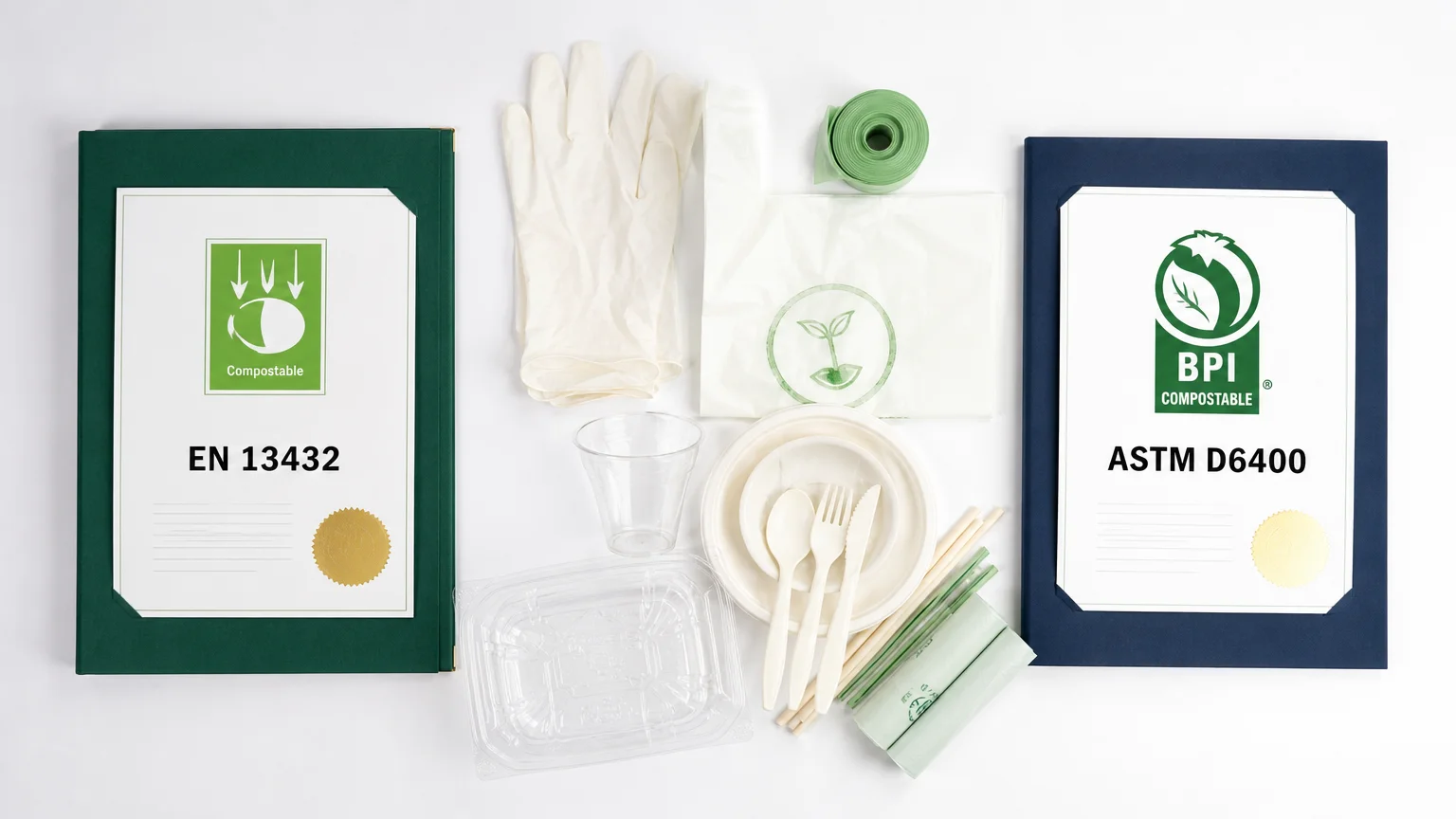
The key rule: match the mark to your destination market. European buyers need DIN CERTCO or SEEDLING. North American buyers need BPI. A supplier that holds both removes the risk of needing two qualified sources. This guide unpacks how the two bodies differ in testing, scope, renewal, and what to request from a supplier before you place a bulk order.
How DIN CERTCO and BPI Differ at the Standards Level
Both bodies test compostability, but the underlying standards are not identical. Understanding the standards helps you know what a certificate actually proves — and what it does not.
EN 13432: The European Standard Behind DIN CERTCO
EN 13432 is the European standard for packaging recoverable through composting and biodegradation. It defines four test criteria: biodegradation (at least 90% of carbon converted to CO2 within 6 months), disintegration (less than 10% of original mass remaining after 12 weeks of composting), ecotoxicity (no harm to plant germination or growth), and heavy metal limits (concentration thresholds for regulated metals). A product must pass all four to earn a DIN CERTCO or SEEDLING mark under EN 13432.
EN 13432 was designed for industrial composting conditions: controlled temperature, moisture, and aeration that home compost heaps cannot reliably provide. The standard does not test home compostability. If your buyer needs a home composting claim, you need SEEDLING's home compost extension — not just DIN CERTCO.
ASTM D6400: The North American Standard Behind BPI
ASTM D6400 is the standard specification for labeling plastics designed to be aerobically composted in municipal or industrial facilities. Like EN 13432, it covers biodegradation, disintegration, and ecotoxicity — but the test conditions and thresholds differ slightly. ASTM D6400 specifies a 45-day disintegration window and uses US composting facility conditions as the reference environment. BPI certifies against ASTM D6400 and also accepts ASTM D6868 for coated paper substrates.
For context on how ASTM standards are structured and maintained, see Wikipedia, ASTM International. BPI-certified products appear in the public BPI product database, which US composting facilities use to verify acceptance claims. See also Wikipedia, Compostable plastic for background on how composting certification differs from basic biodegradability claims.
DIN CERTCO vs BPI: A Direct Comparison
For buyers who need to compare the two bodies side by side, the table below covers the dimensions that matter most in a sourcing decision.
| Factor | DIN CERTCO | BPI |
|---|---|---|
| Issuing body | DIN CERTCO GmbH (Germany) | Biodegradable Products Institute (USA) |
| Underlying standard | EN 13432 (also accepts EN 14995, ISO 17088) | ASTM D6400 (also accepts ASTM D6868) |
| Primary market | Europe (EU + UK tenders, European retailers) | North America (US + Canada composting programs) |
| Composting environment | Industrial only (SEEDLING home-compost extension available separately) | Industrial / municipal composting only |
| Product scope | Per product, per certificate number — factory-wide claims not valid | Per product, listed in BPI product database |
| Certificate lookup | DIN CERTCO online certificate database | BPI certified product database (public) |
| Renewal cycle | Annual audit; certificate number remains if renewed | Annual recertification; re-test required if formulation changes |
| Worldchamp cert | No. 9G0275 (compostable gloves; industrial composting) | Certificate No. 10529018-3; current sublicense No. 2486563-4 (listed glove SKUs only) |
Key Factors to Compare When Sourcing
Once you know which standard your destination market requires, five additional checks separate a real compostable product from a marketed one.
1. Destination Market Determines the Mark
European buyers — particularly those supplying supermarkets, food retailers, or municipal programs — typically require DIN CERTCO or SEEDLING as a tender prerequisite. If your buyer is in Germany, France, or the UK, they will likely know EN 13432 by name and ask to see the certificate number.
North American buyers — especially those supplying foodservice distributors, grocery chains, or municipal compost programs in California or New York — need BPI. The BPI product database is used by composting facilities to confirm which products they will accept. If your product is not in that database, composting facilities may reject it regardless of the label claim. Retail and supermarket programmes that must carry a verifiable mark at checkout are covered in more detail under supermarket and retail compostable bag sourcing.
2. Scope Must Match Your Exact Product
A compostable mark is awarded to a specific product, not a factory or a product family. The document must name the exact product you are buying. Worldchamp's current BPI sublicense No. 2486563-4, based on manufacturer Certificate No. 10529018-3, lists WPP-GL001 sold as three Planetgards glove SKUs. It does not cover other glove SKUs or Worldchamp's compostable bag line, which is supported by a separate Biodegradable Plastic Bag Inspection Report No. WT20103211073930WT1 (CNAS accredited lab). Never let a supplier use a glove certificate to support a bag claim, or vice versa.
3. Verify the Certificate, Not the Logo
Both DIN CERTCO and BPI maintain public lookup tools. For DIN CERTCO, search by certificate number on the DIN CERTCO certification database. For BPI, search the BPI product database by brand or product name. A logo on a website is not a certificate. If a supplier cannot provide the certificate document — with the issuing body, the certificate number, the product scope, and the validity date — treat the claim as unverified.
4. Industrial vs Home Composting: Know the Scope
Both DIN CERTCO and BPI certify for industrial composting only. Many buyers assume a compostable mark covers home composting — it does not. If your retail buyer makes a home-compostable claim on packaging, you need a product that has passed a separate home compost standard.
In Europe, SEEDLING offers a home-compost extension under EN 13432 plus additional home-composting criteria. In North America, no widely accepted home compost standard exists for disposable products at this time. Confirm the exact scope of any mark before printing it on packaging.
5. Food-Contact Compliance Is a Separate Layer
Compostable certification proves end-of-life behavior in a compost environment. It does not prove food-contact safety. If your compostable product will touch food — a compostable glove used in a kitchen, or a compostable bag used to package fresh produce — you still need a market-specific migration test report.
For the US market, that means compliance with FDA 21 CFR. For the EU, it means compliance with EU Regulation No. 10/2011 on plastic materials intended to contact food. Worldchamp's factory holds BRCGS Consumer Products Certificate No. CN-BRCCP-251634 and ISO 9001 Certificate No. 77067/A/0001/UK/En — these are factory quality system certificates, not product food-contact certifications. Request the matching migration report for your target market separately.
Which Compostable Products Does Worldchamp Certify?
Worldchamp's certifications cover two separate product lines with different documentation stacks. Buyers should request the document that matches the exact product they are sourcing.
Compostable Glove Line: Three Certification Marks
Worldchamp has glove documentation for DIN CERTCO No. 9G0275, SEEDLING No. 7P1218, and BPI manufacturer Certificate No. 10529018-3. The current BPI sublicense is No. 2486563-4, valid through April 30, 2028, and lists only WPP-GL001 products sold as Planetgards Medium, Large, and X-Large gloves. Confirm the exact requested SKU on the current documents.
For the material science behind the glove compound, see our compostable glove biocompounds materials page. For application and certification verification guidance specific to gloves, see the compostable glove certification guide.
Compostable Bag Line: Third-Party Test Report
Worldchamp's compostable bag products — including garbage bags, shopping bags, and pet waste bags — are supported by Biodegradable Plastic Bag Inspection Report No. WT20103211073930WT1, issued by the Shenzhen Academy of Metrology and Quality Inspection (CNAS accredited laboratory). This is a third-party test report, not a certification body mark.
Buyers sourcing compostable bags should request this report and confirm the product description matches their order spec. If your tender requires a named certification body mark on compostable bags specifically, contact us to confirm current certification status. Do not assume the glove certificates extend to bags; they do not.

Worldchamp Manufacturing Context
Worldchamp operates a 12,000 m² facility in Huizhou, China, with a Class 100,000 clean workshop, monthly capacity of 350 tons, and a product defect rate below 0.1%. The R&D team coordinates third-party certification programs — including DIN CERTCO, SEEDLING, and BPI — end to end, from compound qualification through lab submission and certificate maintenance.
Procurement Action Checklist
- Confirm your destination market — identify whether your buyer or composting program recognizes DIN CERTCO/SEEDLING (Europe) or BPI (North America), and whether industrial or home compost scope is needed.
- Request the certificate document, not the logo — check the issuing body, the certificate number, the exact product scope, and the validity period. Verify using the DIN CERTCO or BPI public database.
- Confirm scope matches your product — ask whether the certificate covers the exact product you are ordering (glove vs bag; exact model), and that the composting environment matches your buyer's packaging claim.
- Request food-contact documentation separately — if your product touches food, ask for the market-specific migration test report (FDA 21 CFR for US, EU No. 10/2011 for Europe) alongside the compostable mark.
Frequently Asked Questions
What is the difference between DIN CERTCO and BPI compostable certification?
DIN CERTCO is a German certification body that certifies against European standard EN 13432. BPI is a North American body that certifies against ASTM D6400. Both require biodegradation, disintegration, and ecotoxicity tests — but the test conditions and thresholds differ slightly, and each mark is recognized in its home region. European buyers expect DIN CERTCO or SEEDLING. North American buyers expect BPI. A supplier holding both removes the need to qualify two separate sources.
Does DIN CERTCO certification work in the United States?
DIN CERTCO is recognized by European composting programs and retailers, but it is not widely used by US composting facilities. Most US and Canadian municipal programs recognize BPI certification (backed by ASTM D6400) and use the BPI product database to verify acceptance. If you sell into the US market, BPI is the mark to request from your supplier — DIN CERTCO alone will not satisfy US composting facility requirements.
Does BPI certification cover compostable bags and gloves?
Certification scope is product-specific, not factory-wide. Ask for the current certificate or test report, then verify the holder, certificate number, standard, exact material or finished SKU, target market, validity dates, and permitted claim before approval.
What is the difference between industrial composting and home composting?
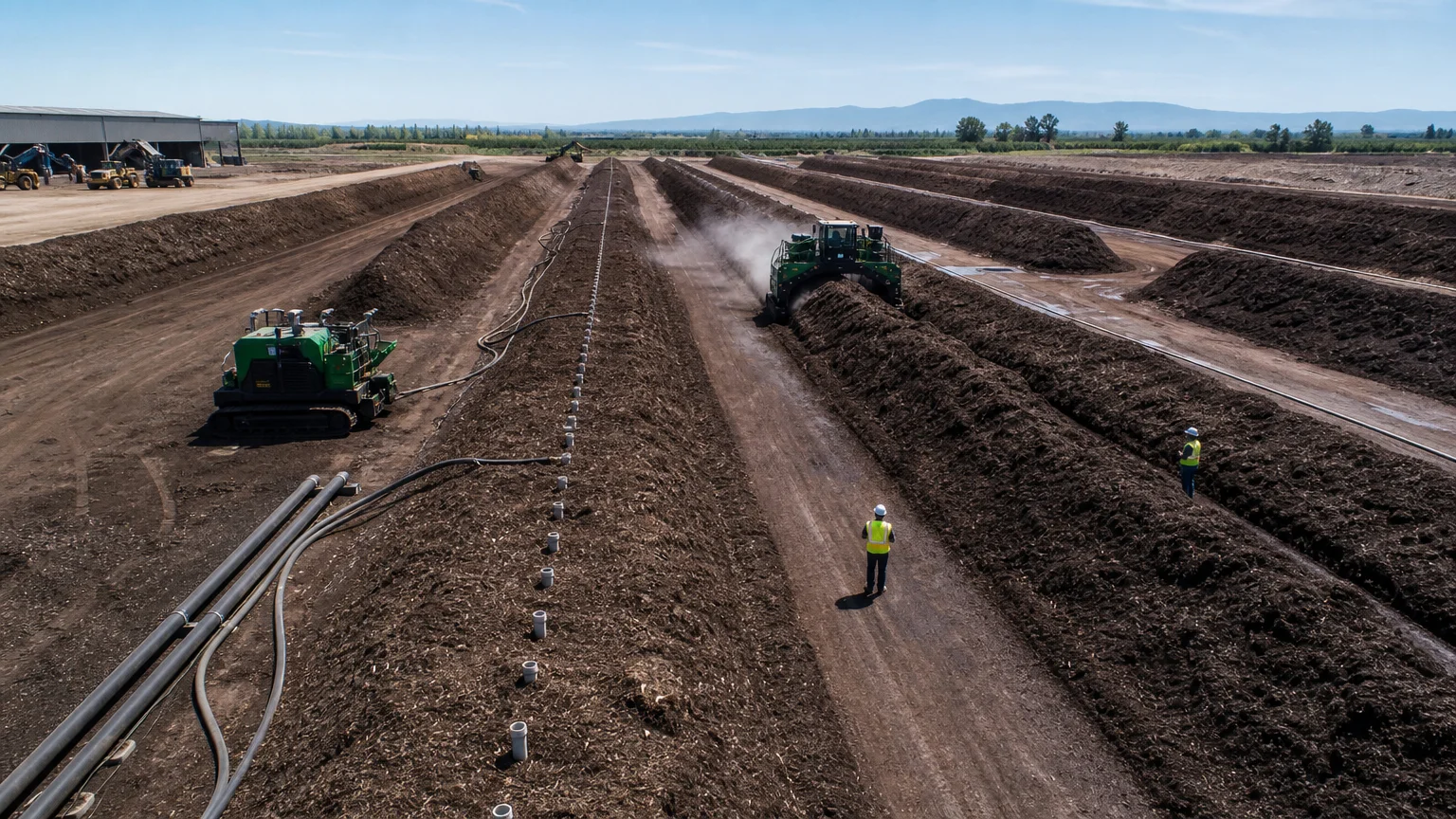
Industrial composting uses controlled high-temperature conditions (typically 55–70°C), managed moisture, and aeration in a facility setting — breaking down certified compostable materials in weeks. Home composting uses ambient temperature and moisture, which varies widely and is much slower. Both DIN CERTCO and BPI certify for industrial composting only. A home-compostable claim requires a separate test and mark, such as the SEEDLING home compost extension in Europe.
How do I verify a compostable certificate is real?
Both DIN CERTCO and BPI maintain public lookup tools. For DIN CERTCO, use the online DIN CERTCO certificate database and search by certificate number. For BPI, use the BPI certified product database and search by brand or product name. Ask your supplier for the certificate document — with the issuing body, the certificate number, the exact product scope, and the validity date — and cross-check it against the public database before placing a bulk order.
What documents should I request when sourcing certified compostable products?
Request the certificate document for each mark your market requires: DIN CERTCO No. 9G0275 or SEEDLING No. 7P1218 for European buyers. For BPI, distinguish Certificate No. 10529018-3 from current sublicense No. 2486563-4 and verify the listed Planetgards SKU. For compostable bags, request Biodegradable Plastic Bag Inspection Report No. WT20103211073930WT1. Add the market-specific food-contact migration report if the product will touch food. Confirm the validity period and that the product scope matches your exact order before the purchase order.
This page owns the regional DIN CERTCO versus BPI decision. For ASTM D6400 scope, product-listing checks and a supplier document checklist, continue to the dedicated BPI certification guide.
Put this guide into a procurement workflow
Use the decision criteria above to narrow the product scope, then Compostable Garbage Bags Bulk Supplier, Compostable Shopping Bags Wholesale Supplier, and Compostable Specialty Bag Sourcing. Compare the exact construction and pack instead of approving a material name alone.
When the product direction is clear, discuss the specification with Worldchamp. Share the task, destination, quantity, packaging and evidence requirements so the next review is specific.
Turn the comparison into a sample and document brief
Share the application, market, quantity, pack format and scope of supporting documents. Worldchamp can then respond against a defined product rather than a generic material request.