The Short Answer on TPE vs POE Gloves
TPE and POE gloves look nearly identical on a shelf. Both are latex-free, both stretch more than standard PE gloves, and both are used across food handling, beauty, and light industrial tasks. But the two materials perform very differently when you stress them.
TPE (thermoplastic elastomer) is a blend of hard plastic and rubber segments. It gives a reasonably soft feel and moderate elasticity. POE (polyolefin elastomer) is a single-chain polymer made via metallocene catalysis. It delivers higher elastic recovery, better tear resistance, and a noticeably smoother, skin-like feel.
Worldchamp context: We manufacture both TPE gloves and POE gloves at our 12,000 m² facility in Huizhou, China — certified to BRCGS Consumer Products Certificate No. CN-BRCCP-251634 and ISO 9001 Certificate No. 77067/A/0001/UK/En. We pioneered the POE glove format in 2024 as an industry first. This guide reflects what we learned from compound formulation trials comparing both materials under real production conditions.
The choice between TPE and POE is not a matter of one being universally better. It depends on your application, your wear-time requirements, and your cost target. This guide breaks down each factor so you can decide with confidence.
What Are TPE Gloves?
Thermoplastic elastomer (TPE) is a category of polymer blends that combine the flexibility of rubber with the processability of plastic. For gloves, TPE typically uses a mix of LLDPE (linear low-density polyethylene) and LDPE with elastomeric modifiers.
The result is a glove that stretches beyond what a plain HDPE or LDPE glove can manage. TPE gloves typically reach 200–300% elongation at break — enough for most food prep and light cleaning tasks. The material returns to shape after stretching, though not as completely as POE.
TPE gloves work well when:
- You need a disposable glove that fits better than basic PE but costs less than nitrile
- Tasks involve short wear times — under 30 minutes
- The primary requirement is food-contact compliance with SGS-level testing
- You are sourcing in high volume where per-unit cost is the main constraint
Worldchamp's TPE Gloves hold an SGS food contact test report confirming compliance with food-handling applications — the only PE-category glove in our range with that specific certification.
What Are POE Gloves?
Polyolefin elastomer (POE) is produced via single-site metallocene catalysis. Unlike TPE's blended structure, POE has a uniform polymer chain architecture. This gives the material tighter control over crystallinity, which directly improves how it behaves under stress.
In glove form, POE delivers 400–600% elongation at break — roughly twice the stretch range of TPE. More importantly, POE has a significantly higher elastic recovery rate. When you stretch a POE glove and release it, it snaps back closer to its original shape. TPE recovers partially; POE recovers nearly fully.
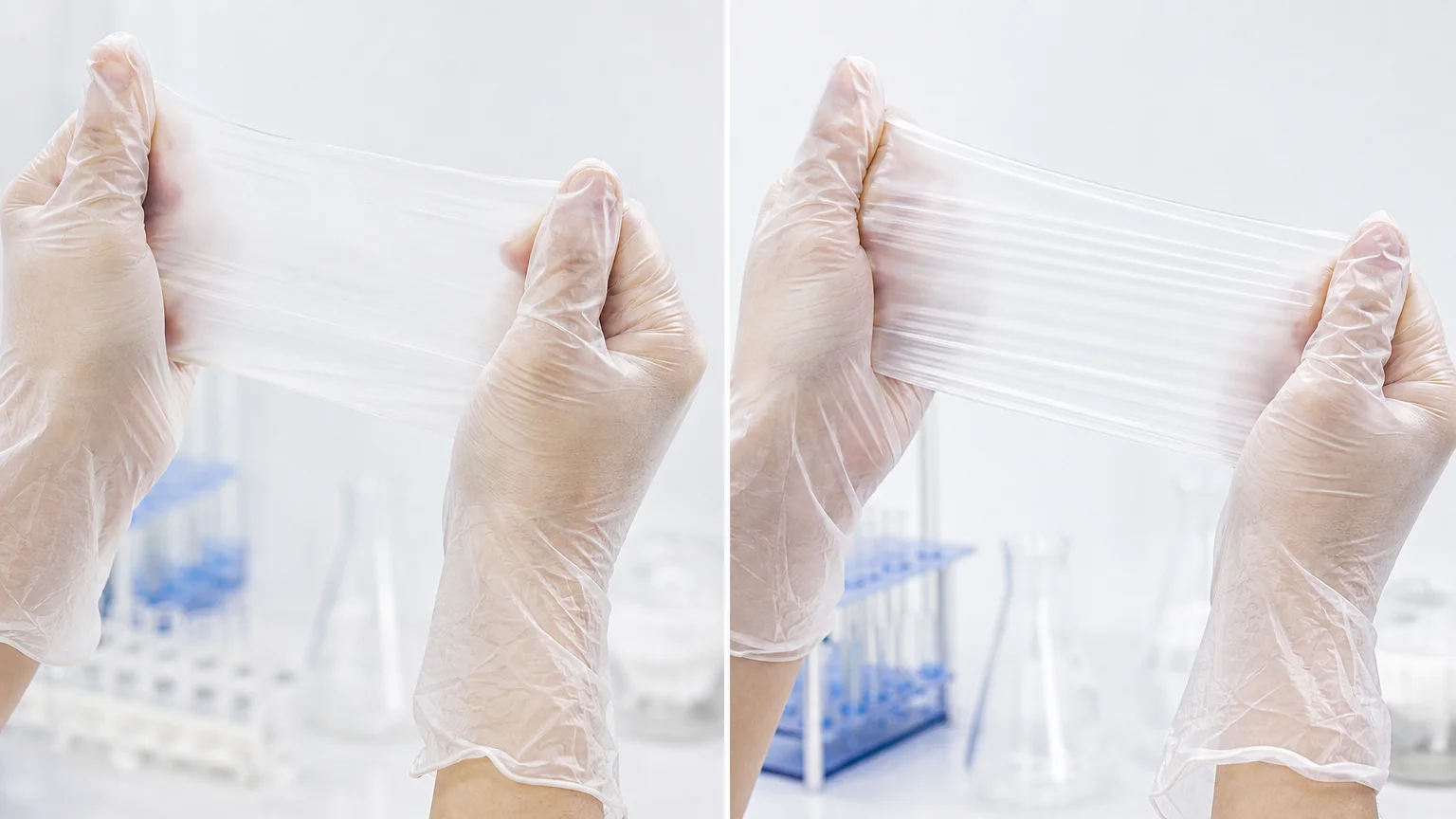
POE gloves perform better when:
- Tasks require a close, form-fitting grip — medical auxiliary, precision food portioning, lab work
- Wear time extends beyond 30 minutes
- Workers report hand fatigue with stiffer glove formats
- You are positioning a premium disposable product that justifies a slightly higher unit price
Worldchamp's POE Gloves were the industry's first POE disposable glove format, launched in 2024 after internal compound formulation trials confirmed the material's superiority for glove applications over standard TPE blends.
TPE vs POE Gloves: Five-Dimension Comparison
The table below compares TPE and POE gloves across the five dimensions that matter most for B2B procurement decisions. All figures reflect Worldchamp's production data and compound testing records.
| Dimension | TPE Gloves | POE Gloves |
|---|---|---|
| Elasticity (elongation at break) | 200–300% | 400–600% |
| Elastic recovery rate | Moderate — partial spring-back after stretch | High — near-full spring-back, form-fitting feel |
| Tear resistance | Good — adequate for short-duration tasks | Superior — resists puncture and micro-tears better under repeated motion |
| Food contact compliance | SGS food contact tested (Worldchamp TPE Gloves) | Manufactured in BRCGS Consumer Products & ISO 9001 certified facility; widely used in food handling |
| Cost per 100 gloves (relative) | Lower — TPE compound is less expensive to formulate | Slightly higher — metallocene POE resin costs more, but less material needed per glove due to better yield |
Neither material is always the right answer. The table shows that POE wins on performance dimensions, but TPE remains cost-competitive for high-volume, short-wear applications where the superior recovery of POE is not needed.
Why Worldchamp Chose POE for Premium Gloves
When our R&D team developed our POE glove line in 2024, the question was straightforward: which material produces a better glove for the tasks our buyers actually use it for?
TPE gloves are fine for light food prep — deli counters, sandwich assembly, produce handling. But buyers in medical auxiliary, beauty, and precision food portioning told us the same thing: the glove slips or bunches during extended wear. The fit feels adequate at first, then becomes uncomfortable.
POE changed that. The metallocene chain architecture means the material conforms better to hand geometry under heat and motion. Workers report less hand fatigue during extended shifts. The glove stays in position rather than sliding or creasing at the knuckles.
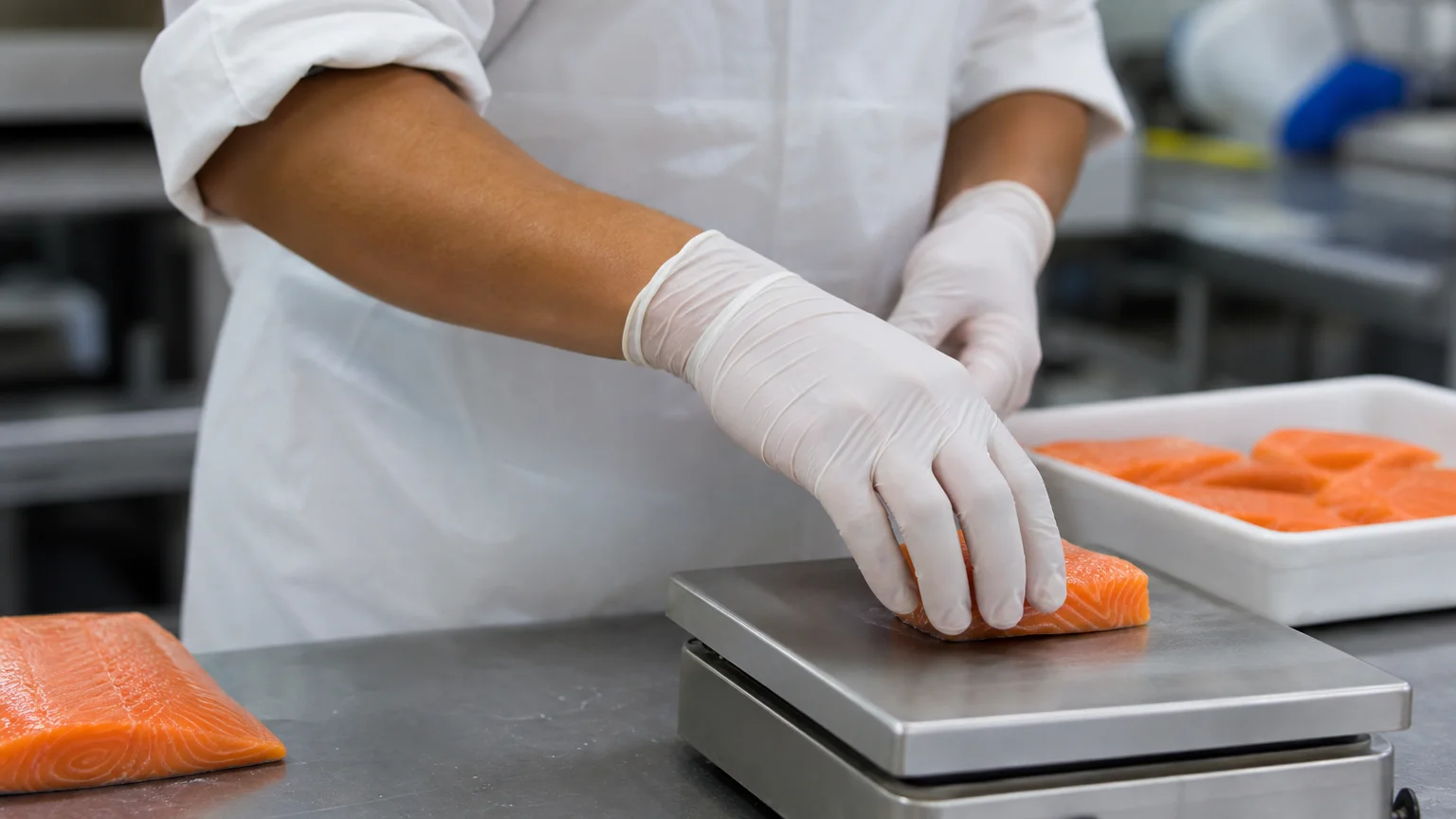
The second reason is durability. Disposable gloves have a per-use cost, but they also have a mid-task failure rate. A TPE glove that tears during a task means the worker stops, disposes, re-gloves. That interruption adds cost in labor-intensive lines. POE's higher tear resistance reduces mid-task failures. For food processing lines running 20 tons per day of throughput, that operational continuity has measurable value.
We produce POE gloves at our Class 100,000 clean workshop, with a defect rate below 0.1% across all production batches. For buyers evaluating a material switch from TPE to POE, we recommend requesting a mixed sample set — both materials, same size, same task — and comparing wear comfort after 60 minutes of real use.
For the broader question of why POE outperforms TPE across the polyolefin glove category, see our POE compound properties page for technical specifications, or the POE material innovation hub for R&D context.
Food Contact and Compliance: What Changes Between TPE and POE?
Food contact compliance is one of the most common decision points when sourcing disposable gloves. Here is how TPE and POE differ in terms of available documentation.
TPE Gloves — SGS Food Contact Tested
Worldchamp's TPE Gloves hold an SGS food contact test report. This is a third-party migration testing document confirming that the specific glove formulation does not transfer regulated substances beyond the limits set by FDA 21 CFR and EU No. 10/2011 frameworks at test conditions.
If your buyer or distributor requires a specific food contact test report at the glove level, TPE is the documented option in our range.
POE Gloves — Facility-Level Certification + Food Use
Our POE Gloves are manufactured in a facility certified to BRCGS Consumer Products Certificate No. CN-BRCCP-251634 and ISO 9001 Certificate No. 77067/A/0001/UK/En. These certifications validate the quality management system, not product-level food contact migration limits.
POE gloves are widely used in food handling globally. For buyers requiring market-specific food contact compliance documentation (FDA 21 CFR, EU No. 10/2011), we recommend contacting us with your target market and regulatory framework. We coordinate with third-party labs to support documentation needs.
Which Material to Specify for Food Applications?
If your documentation requirements include a glove-level SGS food contact test report today, specify TPE. If your requirement is facility certification plus food-safe use confirmation, either material qualifies with our current documentation. See our PE gloves food safety guide for a broader treatment of food contact compliance across material types.
Application Decision Guide
Use this guide to match the right material to your specific application.
Choose TPE Gloves When:
- Wear time is under 30 minutes — food counter service, sandwich prep, cashier-side food handling
- Volume is high and cost is the primary constraint — foodservice chains, supermarket delis, cafeteria lines
- A glove-level SGS food contact test report is required — for export documentation to specific markets
- Task demands basic stretch without precision fit — bulk produce handling, light assembly, household cleaning
Choose POE Gloves When:
- Wear time exceeds 30 minutes per shift — food processing lines, beauty salon color applications, medical auxiliary tasks
- Grip and form fit matter — precision food portioning, lab specimen handling, fine motor work
- You are building a premium private-label SKU — POE positions better against nitrile in consumer perception than TPE does
- Mid-task glove failures are a problem — POE's tear resistance reduces interruptions in high-throughput lines
For buyers evaluating TPE and POE together against other materials, the POE vs nitrile glove material comparison and the TPE vs PE gloves comparison provide additional context across the polyolefin and elastomer glove family.
Worldchamp Manufacturing Context
We manufacture TPE and POE gloves at the same facility, which means we can offer like-for-like sample comparisons from a single source. Our facility specifications:
- Capacity: 20 tons per day / 350 tons per month
- Clean workshop: Class 100,000 clean room environment, certified
- Defect rate: below 0.1% per batch, with retained samples for traceability
- MOQ: USD 3,000 minimum order value (supports small-volume trials)
- Sample lead time: approximately 7 days
- Production lead time: 20–30 days from deposit confirmation
We support OEM and private label orders for both TPE and POE formats, including custom sizing, color, and packaging specifications. Our POE glove material innovation page documents the R&D background behind the 2024 POE glove launch for buyers who want technical depth before qualifying us as a supplier.
Procurement Action Checklist
- Define wear time and task type — under 30 minutes and light tasks point to TPE; extended wear and precision tasks point to POE.
- Confirm documentation requirements — if a glove-level SGS food contact test report is required, specify TPE in your RFQ.
- Request a mixed sample pack — ask for TPE and POE in the same size to compare fit, stretch, and tear resistance under real conditions before committing to a production order.
- Evaluate total cost, not just unit cost — count mid-task failure rates and re-gloving labor when comparing TPE vs POE per-use cost.
Not Sure Whether TPE or POE Fits Your Application?
Tell us your task, wear time, and target market. We will send a TPE and POE sample pack from our BRCGS-certified facility and quote with the compliance documents you need.
Frequently Asked Questions
What is the main difference between TPE and POE gloves?
TPE (thermoplastic elastomer) gloves use a blended polymer structure offering 200–300% elongation. POE (polyolefin elastomer) gloves use a metallocene single-chain architecture offering 400–600% elongation with higher elastic recovery. POE fits more closely, tears less, and performs better in extended wear; TPE costs less per unit for short-duration tasks.
Are POE gloves better than TPE gloves for food handling?
For short-duration food tasks under 30 minutes, TPE is a cost-effective choice and holds an SGS food contact test report. For extended food processing work over 30 minutes where fit and tear resistance matter, POE performs better. Both are manufactured in Worldchamp's BRCGS Consumer Products and ISO 9001 certified facility.
Do TPE and POE gloves have the same food contact compliance documents?
No. Worldchamp's TPE Gloves have an SGS food contact test report at the product level. Our POE Gloves are covered by facility-level BRCGS Consumer Products and ISO 9001 certifications. For buyers who need product-level migration testing for POE, contact us with your target market and regulatory framework — we can coordinate third-party lab submissions.
Can I get POE gloves in custom sizes and private label packaging?
Yes. Worldchamp supports OEM and private label orders for POE gloves from USD 3,000 MOQ. Sample lead time is approximately 7 days. Production lead time is 20–30 days from deposit confirmation. Contact us with your sizing, color, and packaging specifications to start the qualification process.
Why did Worldchamp develop POE gloves instead of just improving TPE?
The metallocene catalyst architecture of POE gives it a uniform polymer chain that simply cannot be replicated by blending existing polymers in TPE. Improving TPE would still leave you with a blended structure and partial elastic recovery. POE's near-full spring-back, higher elongation, and smoother surface feel come from the material's molecular architecture — not from additives or processing tricks. That is why we chose to develop a new POE compound rather than reformulate TPE.