The Short Answer on Compostable Packaging Freight Cost
Compostable packaging does not automatically cost more to ship than conventional plastic. Freight depends on the finished product weight, carton dimensions, units per carton, total carton count and transport method. Compare both materials against the same functional specification before assigning the difference to the material.

A lower bag price can still produce a higher delivered cost when the packing format uses more cartons or more shipping volume. A higher product price can sometimes keep a similar freight allocation when the bag weight and carton efficiency remain close to the PE reference.
Worldchamp does not publish a universal freight percentage because the current project contains no fixed unit weight, carton CBM, container loading quantity or route quotation. The useful answer is a repeatable comparison method that buyers can apply to a real specification.
Why Material Price Is Not the Same as Delivered Cost
Two quotations that use the same nominal bag size may still differ in thickness, seal construction, folding, roll count, core, inner pack and carton quantity. Those variables change both product weight and shipping volume.
A fair comparison starts with the same use case, dimensions, closure and performance target. If the physical brief changes between quotations, the freight difference cannot be attributed to compostable material alone.
Three Numbers That Drive the Freight Comparison
Ask each supplier to quote the finished, packed product rather than only a resin price or price per kilogram.
1. Total Shipment Gross Weight
Gross weight includes the bags, inner packs, cores, retail boxes and export cartons. Calculate the shipment basis as carton gross weight multiplied by carton count.
2. Total Carton Volume
Calculate each carton volume from its external length, width and height, then multiply by the carton count. The carrier may charge by weight, volume or equipment type depending on the route and transport method.
3. Freight per Usable Unit
Divide the relevant freight cost by the number of usable bags, rolls or retail packs delivered. This exposes cases where a lower carton count or tighter pack reduces the freight allocated to each selling unit.
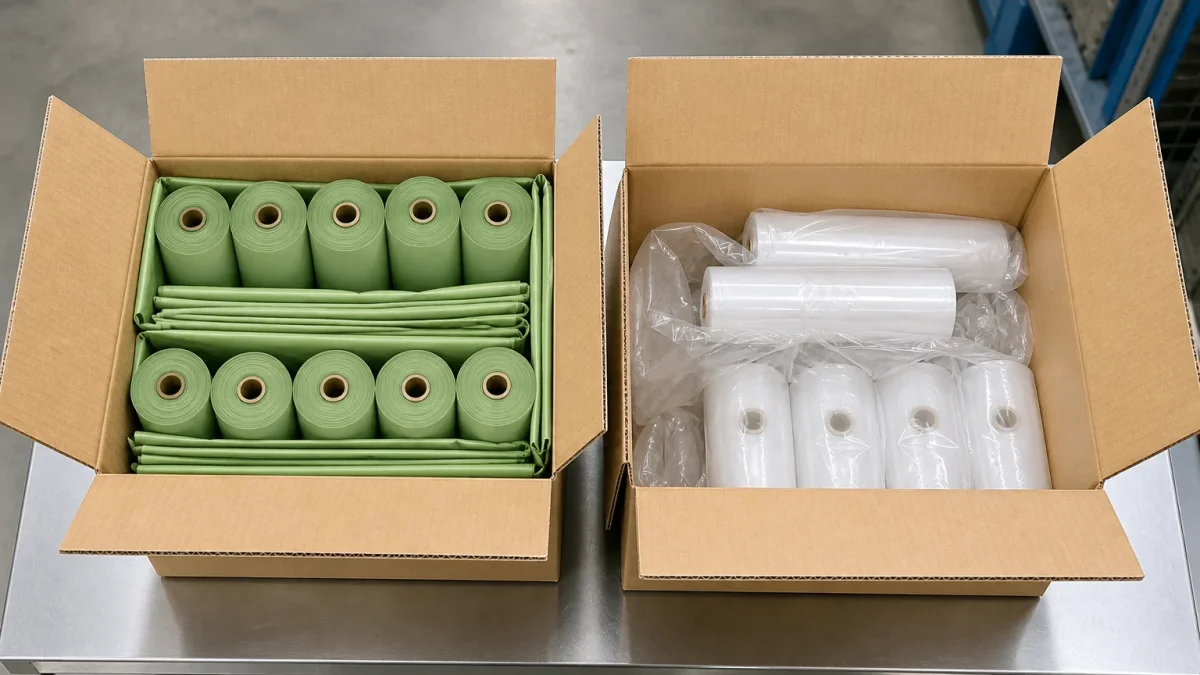
Use One Specification Sheet for Both Materials
Record the following fields for both the compostable and PE option. Values should come from the approved construction and packing sample, not from a generic product listing.
| Comparison field | What to confirm |
|---|---|
| Use case | Waste collection, retail carrying, pet waste, takeout or another defined task |
| Bag construction | Flat, T-shirt, star seal, gusset, drawstring, perforated roll or another format |
| Finished dimensions | Length, width, gusset, handle and seal dimensions |
| Thickness basis | Target thickness, tolerance and required use performance |
| Finished unit weight | Measured bag, roll or retail-pack weight |
| Inner packing | Loose, folded, rolled, core, inner bag or retail box |
| Carton loading | Units per roll, rolls per carton and total units per carton |
| Carton data | External dimensions, net weight and gross weight |
| Shipment basis | Quantity, destination, transport method and quoted delivery boundary |
A Practical Landed-Cost Calculation
Use the same order quantity, destination and delivery scope for both alternatives. Otherwise the result may reflect different commercial terms rather than different packaging.
The calculation can be kept simple enough for a quotation comparison sheet:
Shipment gross weight = carton gross weight × carton count
Shipment volume = carton length × width × height × carton count
Freight per unit = relevant freight cost ÷ usable delivered units
Landed cost per unit = product cost + packing cost + freight allocation + destination logistics + expected handling or loss cost
Do not insert an assumed freight percentage before these inputs are known. Request an estimate first, then replace it with the final packing data after the sample and carton arrangement are approved.
Design Choices That Can Change Shipping Cost
Thickness Set Without a Use Test
Increasing thickness raises unit weight, but reducing thickness without testing can create sealing, opening or carrying failures. Set the construction through a sample and actual-use check.
Low Units per Carton
A lower carton quantity increases the number of cartons required for the same order. More cartons can increase shipment volume and handling.
Roll and Core Decisions
Roll count, perforation, roll diameter and core design affect how efficiently the product fits inside the carton. The lowest-volume option still has to dispense correctly.
Retail Packaging and Empty Space
Individual packs and retail boxes may support shelf presentation but reduce carton density. Recheck the export carton after the retail pack is approved instead of automatically reusing the PE carton.

Five Steps for a Comparable Freight Review
Use the following sequence before approving a material switch.
- Lock the same functional brief — Keep use, dimensions, seal, closure and performance requirements consistent.
- Approve physical samples — Test opening, sealing, perforation, carrying and the actual contents or waste stream.
- Measure the packed result — Record unit weight, roll count, carton quantity, carton dimensions, net weight and gross weight.
- Quote the same route — Use the same quantity, destination, transport mode and delivery scope for both options.
- Compare per-unit landed cost — Review cost per bag, roll, inner pack or retail unit instead of stopping at price per kilogram.
Information to Include in a Supplier Request
A supplier can only estimate packing and freight when the physical and commercial boundaries are clear.
- Bag use and contents
- Bag format and finished dimensions
- Thickness or performance requirement
- Color, print and closure requirements
- Fold, roll, core and inner-pack format
- Retail-pack and carton quantity target
- Order quantity
- Destination country or port
- Expected transport method and delivery boundary
Worldchamp Bag and Packing Context
The current Worldchamp project confirms that bag dimensions, thickness, color, perforation, roll count, core, folding and cartons can be discussed as configurable order variables and confirmed through samples. It does not provide one universal carton or freight figure for every compostable bag.
Use the broader plastic-versus-compostable guide for the material decision. Then review the compostable bags range, compare garbage-bag formats and shopping-bag formats, and use the custom compostable bag workflow when the pack construction needs to be developed around a specific program.
Frequently Asked Questions
Are compostable bags always heavier than PE bags?
No. Finished weight depends on dimensions, thickness, construction, seal and pack format. Compare approved samples instead of assuming the material name determines the weight.
Does compostable packaging always have higher ocean freight?
No. Ocean-freight allocation also depends on carton volume, carton count, route, equipment and delivery scope. A packed-shipment comparison is required.
Can I compare the two options by price per kilogram?
Price per kilogram is useful for a material discussion, but it does not show whether both bags meet the same task or use the same packing volume. Compare finished-unit and landed cost as well.
Can a supplier give exact freight before samples?
A supplier can provide an estimate, but the result becomes more reliable after dimensions, thickness, pack count and carton arrangement are approved.
Does reducing thickness always reduce delivered cost?
Not necessarily. Lower weight may reduce one cost input, but a bag that fails in use can create waste, repacking or claims. Confirm performance before approving the reduction.
Turn the Guide into a Packing and Freight Brief
Use the fields above to create one comparison sheet for both material options. Keep the product task and delivery boundary fixed so the quotation explains a real difference.
When the format is clear, discuss the specification with Worldchamp. Share the task, destination, quantity, fold or roll format and target carton arrangement.
Compare a Finished Pack, Not a Material Label
Send the intended use, bag dimensions, packing format, quantity and destination so the next discussion can focus on measurable carton and freight inputs.