The Short Answer on Disposable Aprons for Food Processing
A disposable apron for food processing is a thin plastic body cover worn over work clothes to block water, grease, blood, and food soil from reaching the worker and the product. In most food plants it is the cheapest, fastest garment to swap when a zone changes or a worker moves between raw and ready-to-eat areas. The right apron is not about the thickest film, but the right material, thickness, and size for the task, made in a facility with clean production and traceable batches.
Worldchamp (HuiZhou) Plastics Products Co., Ltd. has manufactured disposable PE protective wear since 1997 from a 12,000 m² plant with a Class 100,000 clean workshop. A public file references BRCGS Consumer Products Certificate No. CN-BRCCP-251634 and ISO 9001 Certificate No. 77067/A/0001/UK/En; request the current originals, validity and scope before relying on either certificate. A disposable PE Apron is part of the protective wear line described in the published BRCGS scope.
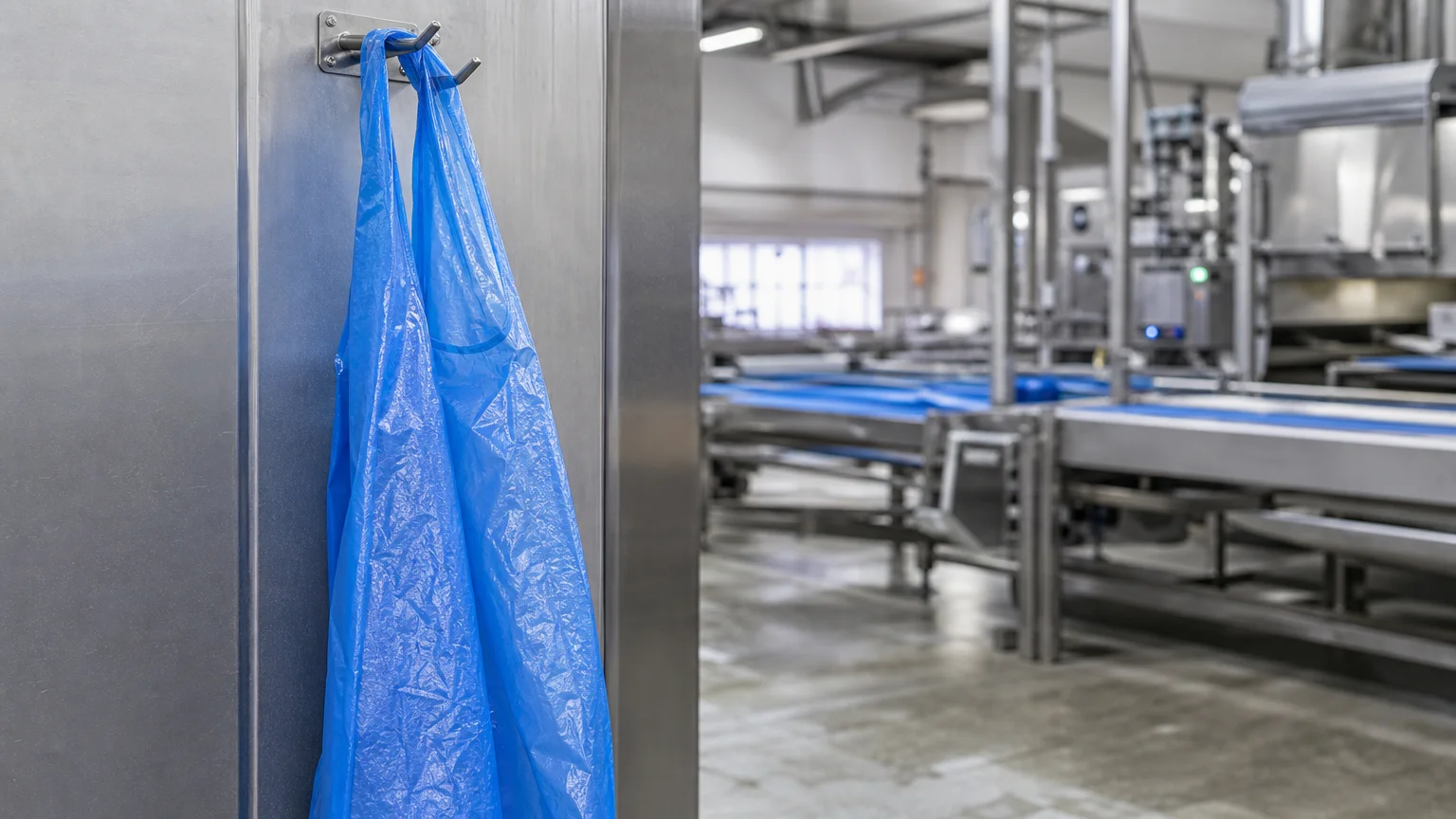
Food buyers often confuse two things. A factory certification proves the production system is controlled. It does not by itself prove a specific apron has passed a food-contact migration test. This guide keeps that line clear, so you ask the right documents and do not over-claim to your own customers. For background on apron types and how they are worn in industry, see Wikipedia, Apron.
What a Food Processing Apron Actually Has to Do
A food processing apron may face water spray, animal fat, blood, brine, sauces, and incidental contact with approved cleaning solutions. No PE or CPE apron should be assumed to resist every chemical. Suitability must be checked against the product documentation and the plant's risk assessment. During its assigned wear period, the apron should stay intact, resist soaking through, and tear off cleanly when it is time to change.
The job splits into four demands. The film must block liquid so soil stays on the outside. It must hold up to the task without ripping at the neck or ties. It must be easy to don and remove, because workers change aprons many times a day. And it must trace back to a batch so a quality problem can be isolated instead of recalling the whole order.
U.S. food plants follow current good manufacturing practice requirements in 21 CFR Part 117, Subpart B. Section 117.10(b)(1) requires personnel to wear outer garments suitable to the operation. Those garments must protect against allergen cross-contact and contamination of food, food-contact surfaces, or food-packaging materials. Read the rule at eCFR, 21 CFR 117.10. A disposable apron can support that hygiene control when it matches the task and the plant's risk assessment.
Key Factors to Compare
When you compare aprons from different suppliers, the spec sheet can look similar. The differences that matter for food processing sit in a few clear factors. Use this list as a checklist on every quote.
1. Material: PE vs CPE
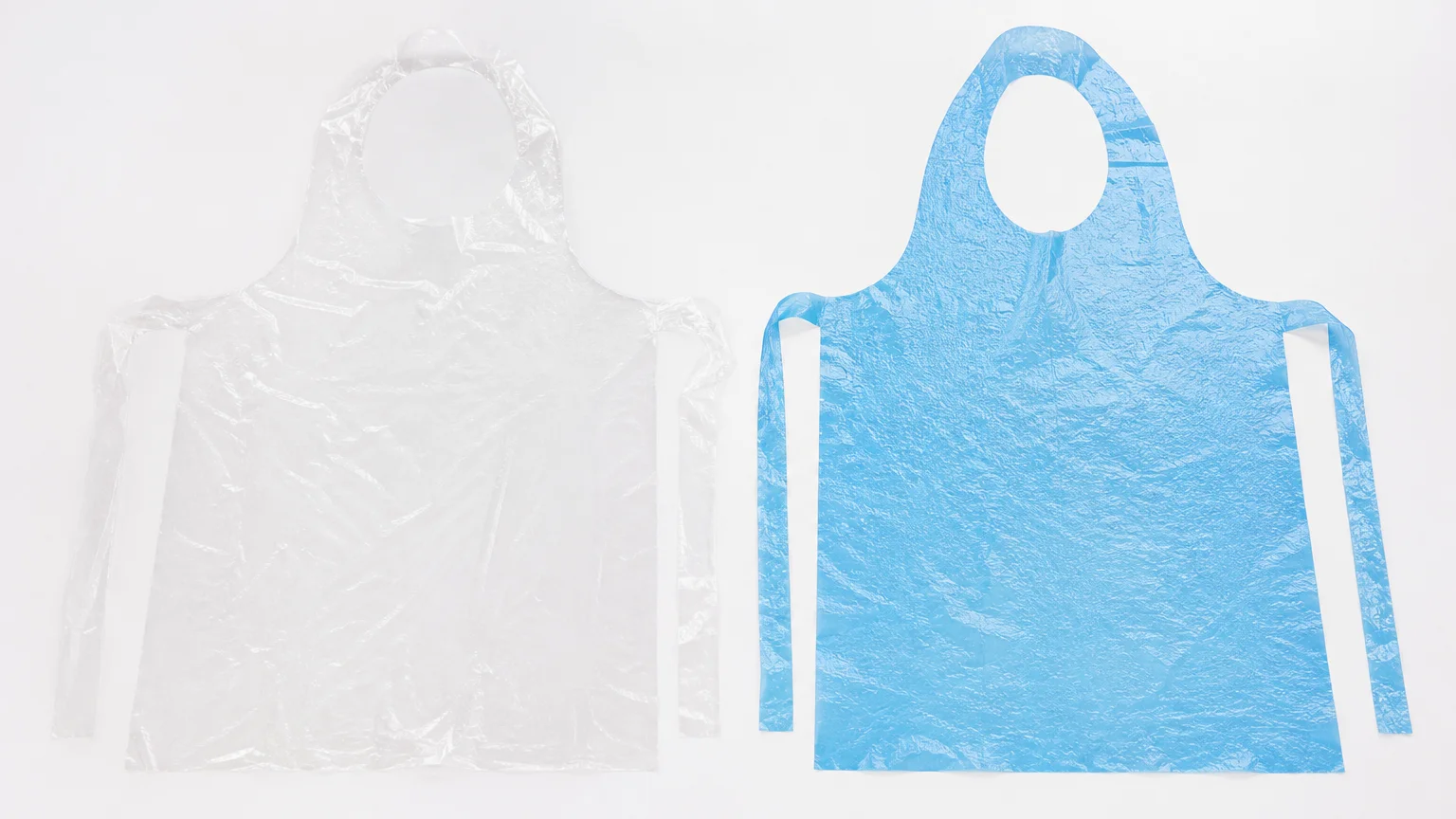
The two common food apron films are PE (polyethylene) and CPE (cast polyethylene). PE aprons are flat, light, and the lowest cost option. They suit short tasks and high changeover. CPE aprons are embossed, slightly thicker, and tougher, with better resistance to routine abrasion and tearing. CPE is usually the better disposable option for longer wear, wet work, and repeated movement. It is not cut-resistant or heat-resistant, so it must not replace task-specific PPE for blades, hot oil, or steam.
Both are polyethylene-based, so both are latex-free and carry no natural rubber allergen. The choice is about durability versus cost, not safety class. For a deeper read on the polymer family, see Wikipedia, Polyethylene.
2. Thickness and Weight
Apron film is sold by thickness, often stated in microns or mils. Light packing and frequent-change tasks may use thinner PE film. Wet or longer-duration work may need a heavier PE specification or CPE, subject to sample and shift testing. Ask for the documented thickness, finished weight, and test samples instead of assuming that one nominal range fits every food plant.
3. Color Coding
Color coding is a core food safety control, not a style choice. Many plants use blue aprons in raw areas and white in ready-to-eat areas, so a dropped piece of film is easy to see against food. Worldchamp PE aprons come in white, blue, and pink, so you can match your plant color plan. Pick colors that fit your allergen and zone separation rules before you lock the spec.
4. Size and Cut
An apron that is too small leaves the chest or lap exposed. One that is too large drags and snags on conveyors. Standard food aprons cover from chest to knee or mid-shin. Check the width and length against your tallest and shortest workers. Also confirm the neck loop and waist ties are strong enough, since the neck and ties are where most aprons fail.
5. Compliance Documents
Ask for the factory system certificates first. The public evidence collection references BRCGS Consumer Products Certificate No. CN-BRCCP-251634 and ISO 9001 Certificate No. 77067/A/0001/UK/En; request current originals, validity and scope before using either claim. These documents describe the production system, not product approval. For market-specific food-contact migration documents under frameworks like FDA 21 CFR or EU No. 10/2011, tell us your target market and we coordinate the right testing path. Never let a supplier blur the line between a factory system cert and a product food-contact test.
6. Batch Traceability
Every apron batch should carry a lot or date code that links back to the production record. Worldchamp retains samples from each batch and handles samples, lot records, and complaints for the proposed SKU. If a customer flags a quality issue, traceability lets you isolate one batch instead of holding the whole shipment. For a food buyer, this is one of the most undervalued factors on a quote.
Match the Apron to the Food Processing Task
Food processing is not one job. A slaughter line, a cook room, a packing station, and a meal-assembly area each stress an apron differently. The table below maps the common food tasks to the apron material that fits best and why. Use it to set the spec for each zone rather than buying one apron for the whole plant.
| Food task | Best apron material | Why it fits |
|---|---|---|
| Raw meat and poultry butchering | CPE apron for splash control, plus task-specific cut protection where blades are used | Handles wet soil and routine movement better than thin PE; it does not protect against knife or bone hazards |
| Fish and seafood processing | CPE apron | Holds up to water spray, scales, and brine over a long shift |
| Cooking and frying zones | Task-specific heat-resistant apron | PE and CPE disposable film are not heat-resistant and should stay away from direct hot oil, hot surfaces, and steam exposure |
| Washing and cleaning stations | CPE apron for routine water splash; chemical-resistant PPE when required | Use only with cleaning agents covered by the supplier's compatibility information and the plant's risk assessment |
| Final packing and labeling | PE apron, standard film | Light and low cost for a clean, low-soil task with frequent changes |
| Meal assembly and plating | PE apron | Comfortable for standing work; cheap enough to change often |
The pattern is simple. Heavy soil, water, and repeated movement may justify CPE. Clean, dry, short tasks are often suitable for PE. Knife, heat, and chemical hazards need separate task-specific PPE and must not be addressed by changing disposable film thickness alone. Many plants stock PE and CPE by zone color. When more arm coverage is needed, pair the apron with a PE Sleeve.
Product and Material Recommendations
Worldchamp builds the food apron line on the PE Apron, with add-ons that cover the rest of the body. The recommendations below fit food processing buyers who want a matched protective wear set rather than a single item.
Start With the PE Apron
The PE Apron is the core item. It is a non-sterile PE film apron in white, blue, or pink, made in a facility with a published BRCGS Consumer Products reference. That factory-system reference is not a product food-contact approval. Use it as your base spec for packing, assembly, and light processing zones. Browse the full range on the disposable apron and cape collection page.
Add Sleeves, Boot Covers, and Gowns by Zone
For raw zones, layer the apron with a PE Sleeve for the arms and a PE Boot Cover for the feet. Where the soil level is high or a full barrier is required, switch the apron for a CPE Gown that covers more of the body. All of these live under the disposable protective wear hub, with sub-collections for gowns and isolation wear and covers and sleeves. Gloves complete the kit — our food handling application page maps glove materials to the same zone-by-task logic.
When to Choose CPE Over PE
- Long shifts in wet zones — CPE resists tearing where a flat PE apron would split.
- Repeated movement and routine abrasion — CPE is less likely to tear during normal handling than thin, flat PE.
- Not for blades or heat — neither PE nor CPE is cut-resistant or heat-resistant. Use rated PPE for knife, hot-oil, or steam hazards.
If your line is mostly clean, dry, and fast-changing, PE may be the lower-cost option. For wetter or longer-duration tasks, consider CPE after a sample and shift trial. If the hazard includes blades, direct heat, or aggressive chemicals, follow the plant risk assessment and use rated PPE instead of relying on disposable film.
Apron vs Gown vs Sleeve: The Layering Decision
Food buyers often ask whether to buy aprons, gowns, or sleeves. They are not substitutes. They are layers, and the right answer depends on how much of the body the task soils. Buying only one type usually means workers are either under-protected or paying for more film than they need.
- Apron — covers the front torso and lap. Best for standing tasks where the front takes the soil.
- Gown — covers the torso and often the back and arms. Best for high-soil zones where a front apron is not enough.
- Sleeve — covers the forearms. Best paired with an apron when the arms, not the chest, take the soil.
A common setup is a PE apron plus PE sleeves for packing and assembly, and a CPE gown where broader splash coverage is needed. Blade, heat, and chemical hazards still require separate rated PPE. This layering keeps cost low in clean zones and improves body coverage in high-soil zones. Plan the mix by zone instead of buying one item for the whole plant.
Worldchamp Manufacturing Context
Worldchamp makes disposable protective wear in a 12,000 m² plant with a Class 100,000 clean workshop and fully automated lines. The published profile states capacity of 350 tons per month. Treat that figure as a planning reference and confirm current availability for the proposed order. The BRCGS Consumer Products scope includes PE apron, sleeve, and bag manufacturing; it describes the factory system and does not replace a product food-contact test.
The factory also produces the matching isolation gowns and covers and sleeves in the same certified system, so you can source a full protective wear set from one supplier and one compliance package.
Next Steps for Procurement
- List your zones — map each food task to PE or CPE and to a color, so you order the right mix.
- Set the spec — fix thickness, size, color, and packaging for each apron type before you ask for quotes.
- Request samples and documents — ask for a sample pack plus the BRCGS and ISO 9001 certificates and a batch code sample.
When you are ready, Contact Worldchamp with your zone list and target market, and we will match the apron spec, send samples, and quote with the compliance documents you need.
Frequently Asked Questions
Do you have to wear an apron when serving food?
In regulated food operations, workers must wear outer garments suitable to the task. Under 21 CFR 117.10(b)(1), those garments must help prevent allergen cross-contact and contamination of food, food-contact surfaces, and food-packaging materials. A disposable apron is one common control, but plant procedures and risk assessment determine whether an apron, gown, or rated reusable PPE is required.
What is the best disposable apron material for food processing?
PE is suitable for clean, short, frequent-change tasks such as packing. CPE offers better tear resistance for wetter or longer tasks. Neither material is cut-resistant or heat-resistant, so knife, hot-oil, and steam work requires task-specific rated PPE. Many plants stock both disposable materials and separate them by zone color.
Is a BRCGS Consumer Products certificate the same as a food-contact test?
No. BRCGS Consumer Products certifies the production quality system, not that a specific apron passed a food-contact migration test. Food-contact compliance is a separate, market-specific test under frameworks like FDA 21 CFR or EU No. 10/2011. Ask for both the factory cert and the migration test path for your market.
What MOQ and lead time should I plan for disposable aprons?
Pre-production sample timing is approximately seven days as a reference. Confirm the current sample and bulk-production schedule after the specification, packaging, artwork, and sample are approved, and state in writing whether the schedule starts from deposit, sample approval, or final artwork approval.
Can I get aprons, sleeves, and boot covers from one supplier?
Yes. Worldchamp makes PE aprons, sleeves, boot covers, and CPE gowns in the same facility. Public files reference BRCGS Consumer Products and ISO 9001 certificates; request the current originals and scope for the proposed SKU. Sourcing the full set from one supplier gives you one document package and consistent batch traceability across the protective wear line.
Turn the comparison into a sample and document brief
Share the application, market, quantity, pack format and scope of supporting documents. Worldchamp can then respond against a defined product rather than a generic material request.