The Short Answer on Gloves for Hair Dye
Salons and beauty distributors need disposable gloves that survive a full color service without tearing, staining, or leaking dye onto the skin. The right glove depends on the task: a quick root touch-up, a full-head permanent color, or a bleach-and-tone session. Material fit matters more than glove thickness alone.
Worldchamp has supported hair and beauty product manufacturing since 2016, including a long-running program with a global hair care brand. Our 12,000 m² facility holds BRCGS Consumer Products Certificate No. CN-BRCCP-251634 and ISO 9001 Certificate No. 77067/A/0001/UK/En, with a Class 100,000 clean workshop and a sub-0.1% defect rate (published reference; scope to be confirmed).
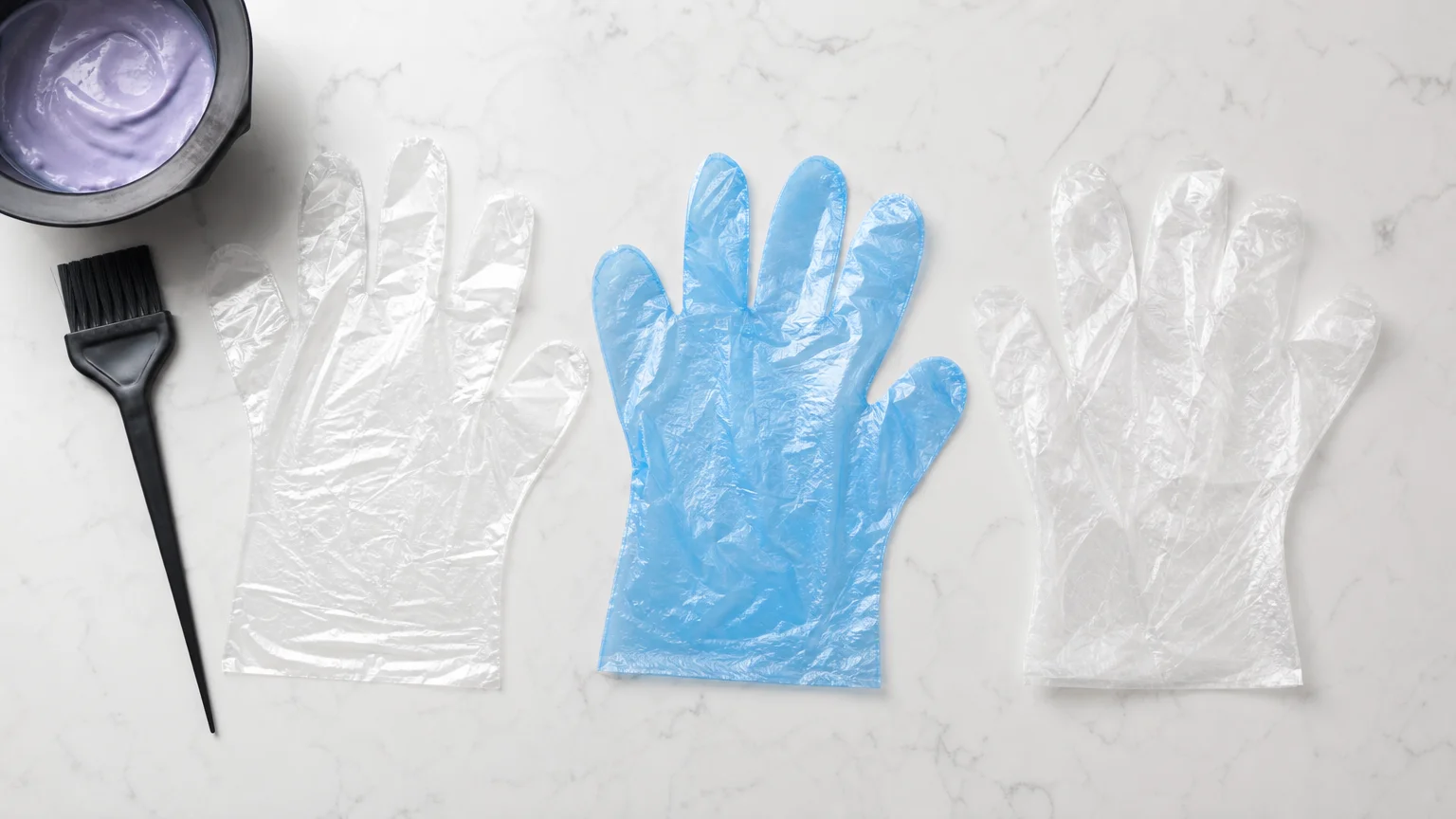
For most B2B beauty buyers, TPE gloves give the best balance of stretch, dye resistance, and cost for repeated color work. CPE gloves work well as a budget option for short tasks and bowl prep. PE gloves fit high-volume, low-contact steps like foiling and cleanup where gloves change often. This guide helps you pick the right mix and qualify a supplier who can deliver it consistently.
What Hair Dye Demands From a Glove
Hair coloring is a chemical process, not just a staining one. Permanent dyes use an oxidizing developer, usually hydrogen peroxide, paired with alkaline agents like ammonia or ethanolamine to open the cuticle so color enters the cortex. Demi-permanent and toning formulas use milder versions of the same chemistry. The gloves you supply must hold up against these agents for the full service time.
Three demands shape the choice. First, the glove must resist permeation from alkaline, peroxide-based mixtures long enough for one client service. Second, it must give the stylist enough stretch and tactile feel to section hair and apply dye precisely. Third, it must be latex-free, because many salon clients and staff have latex sensitivities, and tint often transfers dark pigment that shows any pinhole leak.
The chemistry also explains why a single cheap glove type rarely covers a whole salon. A thin PE glove that works for foiling may split during a 40-minute bleach retouch. A heavy glove that resists bleach may feel too stiff for fine sectioning. Most color bars run a small mix of materials matched to each step.
Match the Glove Material to the Salon Task
Use the table below as a sourcing map. It pairs each common hair-color task with the glove material that fits best, and explains the why behind the fit. This is the core decision a beauty buyer makes when building a glove SKU list.
| Hair color task | Best glove material | Why it fits |
|---|---|---|
| Full-head permanent color, root touch-up | TPE gloves | Elastic fit and peroxide resistance hold up for a 30–45 minute service without splitting |
| Bleach and high-lift lightening | CPE gloves | Heavier film resists alkaline bleach paste longer; textured grip helps with wet sections |
| Foiling, sectioning, bowl and brush prep | PE gloves | Lowest cost per glove for high-changeover steps where gloves swap every few minutes |
| Toning, gloss, and demi-permanent | TPE or CPE gloves | Milder chemistry allows either; choose by how long the stylist wears each pair |
| Cleanup, cape and towel handling | PE gloves | Short, low-contact task where economy and fast changeover beat stretch |
One material is rarely enough. A color bar serving both color and lightening services usually stocks two or three glove types and lets the stylist pick by task. Your supplier should be able to ship all of them under one PO so you avoid splitting orders across vendors.
Key Factors to Compare When Sourcing
Once you know the material mix, evaluate suppliers on factors that affect salon uptime. Price per glove matters, but it is only one of several signals. A supplier that ships cheap gloves with tearing defects will cost more in rework and complaints than a slightly pricier, reliable source.
1. Dye and Chemical Resistance
Ask the supplier how each glove material performs against peroxide-based developers and alkaline lighteners. TPE and CPE films generally resist permeation longer than thin PE. Request sample pairs and run a bench test: fill a glove with developer, seal the cuff, and check for leaks after the longest service time you offer.
2. Stretch, Fit, and Tactile Feel
Colorists section hair and apply dye with precision. A glove that fits like a film, not a bag, reduces hand fatigue and improves accuracy. TPE offers the closest fit to nitrile among polyolefin options. CPE is looser but textured for grip. PE is the loosest and best reserved for short, low-dexterity steps.
3. Latex-Free and Allergen Status
All Worldchamp disposable gloves are latex-free, which is the safe default for salons. Latex sensitivities are common among both staff and clients. Confirm in writing that the glove line you source contains no natural rubber latex, and avoid any supplier that cannot state this clearly.
4. Thickness and Cuff Length
Standard short gloves suit most color work. For bleach and long chemical services, a longer cuff protects the wrist from drips. Match the format to the task rather than buying one thickness for everything. See standard short gloves and extended-length gloves for the two main format families.
5. Packaging and Dispensing
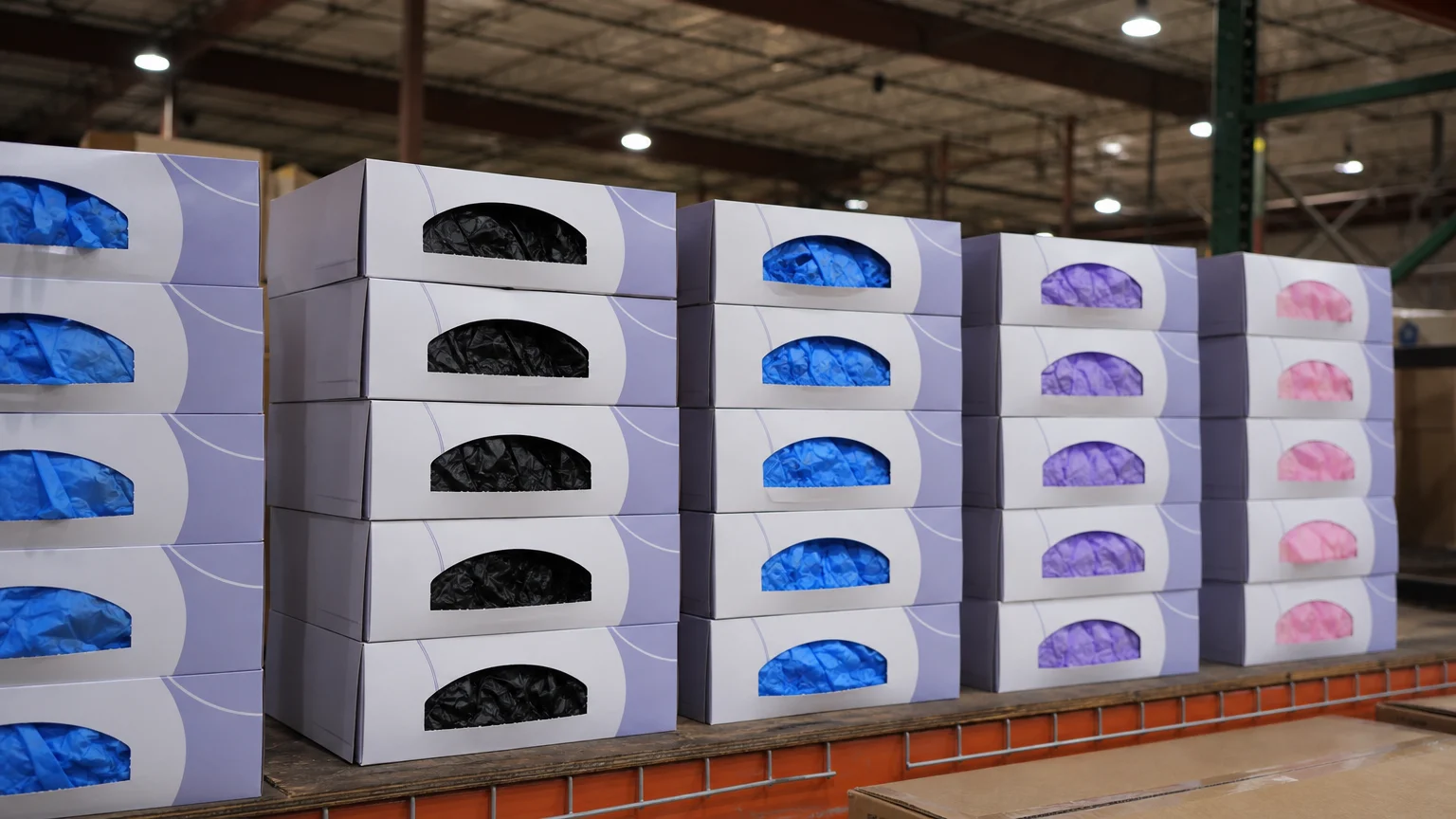
Color bars go through gloves fast. Flat-fold, easy-tear dispensing keeps the station moving. If you private-label for a salon chain, confirm the supplier can do custom box counts and printed dispensers. See dispensing and retail glove formats for packaging options built for high-turnover use.
6. Supplier Compliance and Capacity
Check that the factory runs a documented quality system and can scale with your order growth. Worldchamp produces 350 tons per month across PE, TPE, CPE, and POE lines with a sub-0.1% defect rate (published reference; scope to be confirmed). Our facility holds BRCGS Consumer Products Certificate No. CN-BRCCP-251634 and ISO 9001 Certificate No. 77067/A/0001/UK/En, with a Class 100,000 clean workshop. These are factory system certifications, not product-specific claims; we provide them so buyers can audit the production environment behind every batch.
Product and Material Recommendations
For a beauty buyer building a glove line, here is how the main materials map to hair-color use. Each links to its product detail page so you can request samples by SKU.
- TPE gloves — the workhorse for permanent color and toning. Best stretch and fit in the polyolefin family, closest feel to nitrile. See TPE gloves.
- CPE gloves — heavier, textured film for bleach and lightening where longer chemical contact and grip matter. See CPE gloves.
- HDPE and LDPE gloves — the economy choice for foiling, cleanup, and any short, high-changeover step. See HDPE gloves and LDPE gloves.
If you want a single SKU that covers most of the color bar, lead with TPE and back it with PE for the fast-changeover steps. For more on how these materials differ in fit, strength, and cost, read our TPE gloves vs PE gloves comparison and the broader how to choose disposable gloves guide.
Worldchamp Manufacturing Context for Beauty Buyers
Worldchamp has supplied disposable gloves and protective wear to the beauty and hair care sector for years, including manufacturing support for a global hair care brand since 2016. That experience shows up in how we spec gloves for chemical services: we know which film holds up to peroxide developers and which fits a long color shift.
For salon chains that want branded packaging, we coordinate OEM and private-label runs alongside the glove production. See our hair coloring application page and the beauty salon industry overview for how the full program fits a beauty buyer's sourcing plan.
Procurement Action Checklist
- List your salon tasks — separate permanent color, bleach, toning, foiling, and cleanup so each gets the right material.
- Pick the material mix — lead with TPE for color work, add CPE for bleach, and PE for high-changeover steps.
- Request samples by SKU — test each pair against your longest service time before placing a bulk order.
- Confirm compliance and capacity — ask for BRCGS CP and ISO 9001 certificates, defect rate, and monthly capacity, then place the PO.
Frequently Asked Questions
What gloves are best for hair dye?
TPE gloves are the best all-round choice for hair dye because they stretch, fit close to the hand, and resist peroxide-based developers for a full color service. CPE gloves are a strong second pick for bleach and lightening, where a heavier film and textured grip help. PE gloves work for short, high-changeover steps like foiling and cleanup.
Can I use PE gloves for hair coloring?
Yes, but only for short, low-contact steps. PE gloves are the most economical option and suit foiling, sectioning, and cleanup where gloves change every few minutes. For full-head color or bleach that runs 30–45 minutes, switch to TPE or CPE to avoid tearing and dye seepage.
Are these gloves latex-free?
Yes. All Worldchamp disposable gloves, including the PE, TPE, and CPE lines used in salons, are latex-free. This is the safe default for beauty environments where staff and clients may have latex sensitivities.
What MOQ and lead time should I plan for salon gloves?
Pre-production sample timing is approximately seven days as a reference. Confirm the current sample and bulk-production schedule after the specification, packaging, artwork, and sample are approved, and state in writing whether the schedule starts from deposit, sample approval, or final artwork approval.
Do you supply private-label gloves for salon chains?
Yes. We coordinate OEM and private-label packaging alongside glove production, including custom box counts and printed dispensers. Share your branding and volume needs and we will spec the program with the compliance documents you need for your market.
Put this guide into a procurement workflow
Use the decision criteria above to narrow the product scope, then Disposable Gloves Manufacturer. Compare the exact construction and pack instead of approving a material name alone.
When the product direction is clear, discuss the specification with Worldchamp. Share the task, destination, quantity, packaging and evidence requirements so the next review is specific.
Turn the comparison into a sample and document brief
Share the application, market, quantity, pack format and scope of supporting documents. Worldchamp can then respond against a defined product rather than a generic material request.