Substitution assessment, with a correction
Latex-free disposable gloves: the Kimberly-Clark question, answered
Kimberly-Clark Corporation is a consumer and professional tissue and nonwovens company, incorporated in Delaware in 1928 and listed on Nasdaq (KMB). It sold its entire personal protective equipment business in 2024, so it does not manufacture disposable gloves today. That makes the usual alternative framing misleading, and we would rather correct it than quietly sell against it.
The material question underneath the search is still valid, and this page answers it directly: our gloves contain no natural rubber latex.
The substitution question
A correction rather than a comparison
A page titled alternative to a company's gloves should begin by checking that those gloves still exist. In this case they do not: the PPE business including the Kimtech and KleenGuard ranges was sold in 2024 for approximately USD 635 million, and the buyer was Ansell. Kimberly-Clark's remaining business is tissue, nonwovens and hygiene products. Where it overlaps with us is distribution channel rather than product, because foodservice and janitorial distributors may carry both categories. The honest position is that the latex-free requirement is answerable and the brand comparison is not: this page does the first and declines the second.
What we can genuinely answer
- Whether a glove contains natural rubber latex, evidenced per SKU
- Single-use food handling, food service and light cleaning tasks
- A workplace latex-exclusion policy needing a written declaration
- Buyers who need their own brand rather than a branded glove
- High glove-change frequency where cost per change dominates
What this page cannot do
- Act as a substitute for a glove product Kimberly-Clark still sells, because it does not
- Provide nitrile-grade chemical or puncture performance from a PE film glove
- Offer examination or surgical grade protection
- Cover the tissue, nonwovens and hygiene ranges Kimberly-Clark actually operates in
- Speak to Kimberly-Clark's current materials or certifications, which we did not verify
Decision sequence
Establishing what latex-free actually requires of you
The distinction is usually resolvable in one conversation with whoever wrote the specification.
Ask why latex-free was specified
If the driver is an allergy policy, a polyethylene glove satisfies it. If the driver is that the previous nitrile glove happened to be latex-free, then nitrile performance is the requirement and the phrase was incidental.
Check whether chemical resistance is required
Any requirement for permeation or chemical-resistance data puts you in the nitrile or coated-glove category. Polyethylene film is not the material for that.
Confirm the wear duration
Short wear with frequent change favours PE. Long continuous wear favours nitrile. This single fact resolves most of these sourcing decisions.
Then request the material declaration
A written declaration confirming the absence of natural rubber latex is what a workplace allergy policy needs, and it can be issued for the exact SKU.
Routes that match
Latex-free ranges we manufacture
All of these contain no natural rubber latex. None of them is a nitrile substitute.
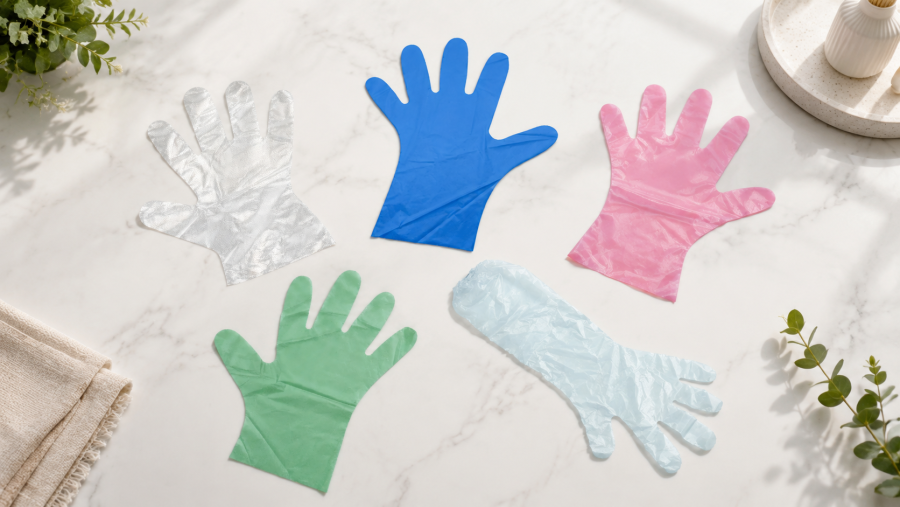
PE and CPE disposable gloves
Latex-free polyethylene and cast film gloves in short, long and extended-cuff formats.
Compare glove materials →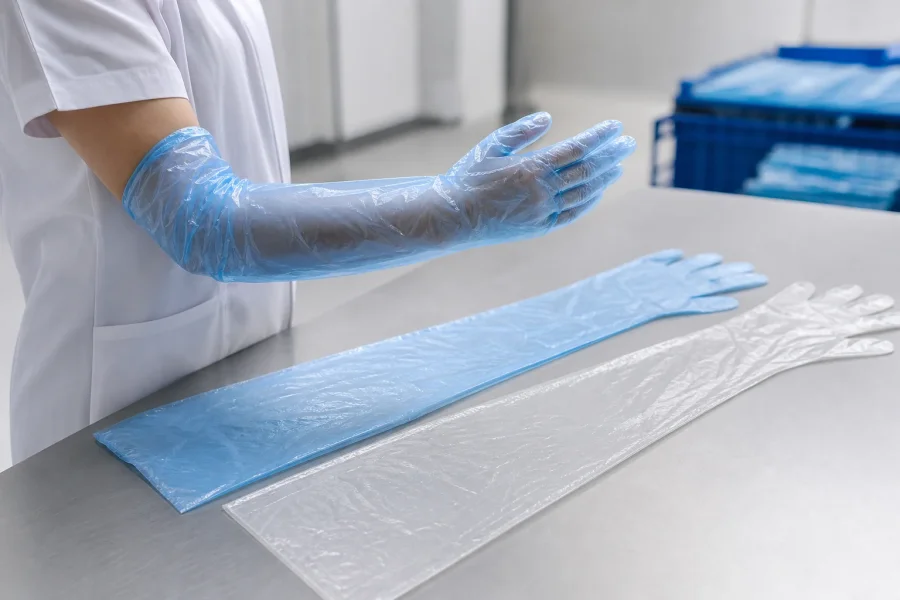
Extended-length gloves
Longer cuff coverage for forearm protection in wet or messy short-wear tasks.
Review extended length →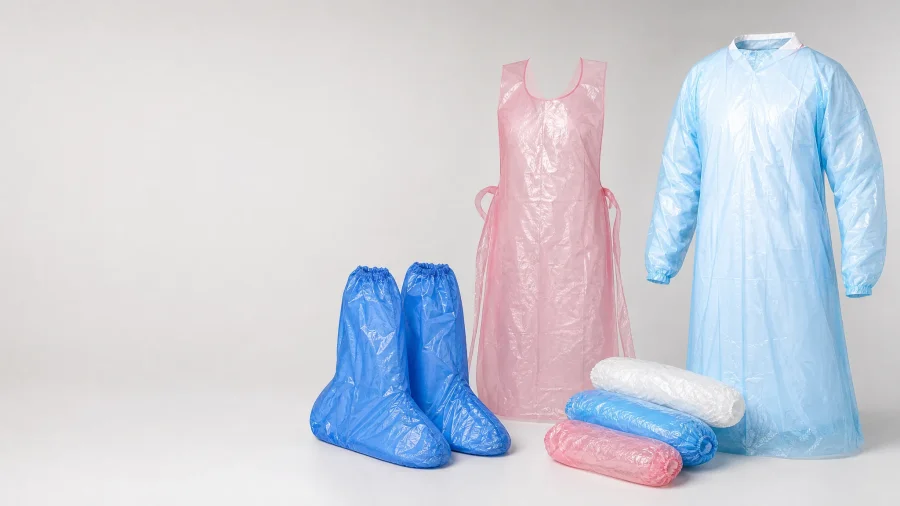
Protective wear
Latex-free aprons, capes, sleeves, gowns and covers for food and hygiene environments.
Review protective wear →Private label and OEM
Your brand, artwork and packaging on a latex-free glove range built to your specification.
See OEM capability →Documents you can verify
Manufacturing evidence and its limits
We publish factory-system evidence with references. A material declaration for latex content is a separate, product-level document.
| Document | Reference | Status |
|---|---|---|
| ISO 9001 quality management | 77067/A/0001/UK/En | Valid to 25 July 2028 |
| BRCGS Consumer Products | CN-BRCCP-251634 (Issue 4, Foundation Level) | Valid to 22 December 2026; scope names PE gloves, aprons, sleeves and bags |
| amfori BSCI social audit | Bureau Veritas, July 2025, overall rating B | Monitoring valid to 16 July 2027 |
| BPI compostability sublicense | 2486563-4 (BPI certificate 10529018-3) | Valid to 30 April 2028; covers only the products named in its file |
Separate the two document types. Factory certificates prove how the site is managed. A latex-content declaration proves what the glove is made of. Both are useful, and neither replaces the other. Ask for the declaration naming the exact SKU.
Approval path
Resolving a latex-free specification
A short sequence that prevents the common error of substituting across material families.
Clarify the driver behind latex-free
Allergy policy or performance requirement. This determines the material family and cannot be skipped.
Select the material and format
PE, CPE, TPE or POE, in the cuff length and pack format the task needs.
Issue the material declaration
A written statement on natural rubber latex content for the exact SKU, for your policy file.
Approve sample and declaration together
So the bulk order matches both the physical glove and the document set you approved.
Buyer questions
Questions buyers ask about the Kimberly-Clark position and latex-free sourcing
These are the questions this page exists to answer.
Does Kimberly-Clark still make disposable gloves?
No. Kimberly-Clark sold its entire personal protective equipment business, which included the Kimtech and KleenGuard ranges covering gloves, apparel, masks, respirators and eyewear, in a transaction valued at approximately USD 635 million that completed in 2024. The buyer was Ansell. So a search for Kimberly-Clark gloves is now looking for a product line that has changed owner, and we prefer to say that plainly rather than imply we are replacing something that still exists.
Then why is this page about latex-free gloves?
Because the underlying material question is still a real one and still worth answering. If your requirement is that a glove contains no natural rubber latex, our polyethylene, CPE, TPE and POE gloves satisfy it. What we will not do is present ourselves as a substitute for a Kimberly-Clark glove product that the company no longer manufactures.
Are your gloves latex-free?
Yes. Polyethylene, CPE, TPE and POE contain no natural rubber latex, so they suit buyers who must exclude latex from a workplace for allergy reasons. A written material declaration confirming the absence of natural rubber latex can be issued for the exact SKU.
Is a latex-free PE glove equivalent to a latex-free nitrile glove?
No. Both are latex-free, but they are different materials with different barrier and durability performance. Nitrile is chosen for chemical resistance, puncture resistance and longer wear. Polyethylene is chosen for low-cost, short-wear single-use tasks. The phrase latex-free describes what is absent, not what the glove can do.
Send the specification, not the brand name
Tell us why latex-free was specified and what the task involves. We will confirm whether a PE glove fits and issue the material declaration your policy needs.