TÜV Austria Compostable Certification: The Short Answer
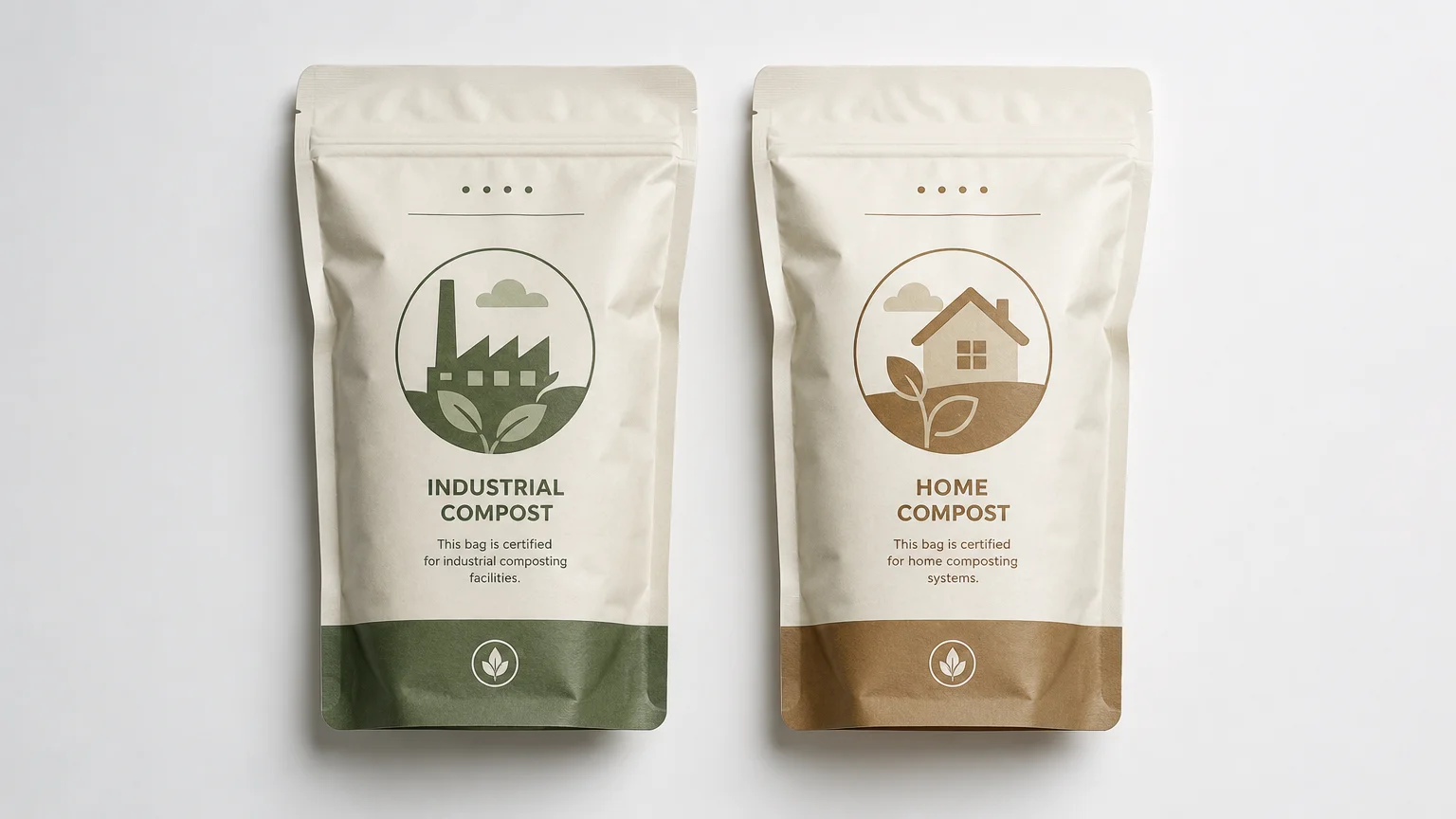
TÜV Austria is an Austrian certification body that tests and licenses the OK Compost family of compostable marks. Their most widely recognized marks in the EU market are OK Compost INDUSTRIAL (for professionally managed composting facilities) and OK Compost HOME (for backyard compost bins). Both are based on the European standard EN 13432, which sets biodegradation, disintegration, ecotoxicity, and heavy metal limits for packaging materials.
If your target market is the EU or you are sourcing from a factory that claims European compostable marks, TÜV Austria certification is one of the most authoritative signals to look for. This guide explains what the marks mean, what EN 13432 actually tests, and how to verify that a certificate is genuine.
What TÜV Austria Actually Is — and Why It’s Not TÜV Rheinland
Buyers often confuse TÜV Austria with TÜV Rheinland. They share the TÜV name, but they are separate organizations. TÜV Rheinland (Germany) covers product safety, electrical equipment, and general industrial testing. TÜV Austria (Vienna) specializes in bioplastics, biomass, and compostability certification. They run the OK Compost label program globally.
TÜV Austria also issues other marks: OK Biobased (bio-based content percentage) and OK Biodegradable (biodegradation in soil or water). For packaging and disposable products, the mark you want to look for is one of the two OK Compost variants — not generic TÜV marks from other branches.
The practical implication for buyers: if a supplier shows a TÜV Rheinland certificate and claims it proves compostability, that is incorrect. Request the specific TÜV Austria OK Compost certificate with a verifiable registration number from the TÜV Austria online database.
OK Compost INDUSTRIAL vs OK Compost HOME: What Changes at the Label Level
The two marks look similar but set very different performance thresholds. The core difference is the composting temperature and timeframe used during testing.
| Mark | Composting environment | Test temperature | Disintegration target | Typical EU use |
|---|---|---|---|---|
| OK Compost INDUSTRIAL | Industrial facility (58°C+) | 58°C maintained | 90% in 12 weeks | Municipal organic waste streams |
| OK Compost HOME | Backyard/garden bin (20–45°C) | Ambient, uncontrolled | 90% in 26 weeks | Consumer packaging, garden waste |
A product with only the INDUSTRIAL mark cannot reliably compost at home. The temperature in a backyard bin rarely reaches 58°C, so degradation stalls. EU municipalities often accept INDUSTRIAL-certified items in green bin collections. HOME-certified items go further and can be placed directly in consumer compost systems.
When sourcing, match the mark to your end-user’s disposal route. If your buyers are in countries with strong municipal composting (Germany, Netherlands, Belgium), INDUSTRIAL is usually sufficient. If end consumers will home-compost the product, HOME is the right spec.
Inside EN 13432: What the Test Actually Measures
EN 13432 is the European standard that underpins both OK Compost marks. TÜV Austria uses it as the test protocol for all certification decisions. Knowing what it measures helps you ask the right questions when evaluating a supplier’s paperwork.
The standard covers four criteria. All four must pass — failing any single one means the product cannot carry the mark.
1. Biodegradation Rate
At least 90% of the organic carbon in the material must convert to CO₂ within 6 months (at 58°C for INDUSTRIAL). This is measured by respiration testing in a lab composting chamber. Materials that fragment but don’t biodegrade — like conventional PE films — fail this criterion.
2. Disintegration
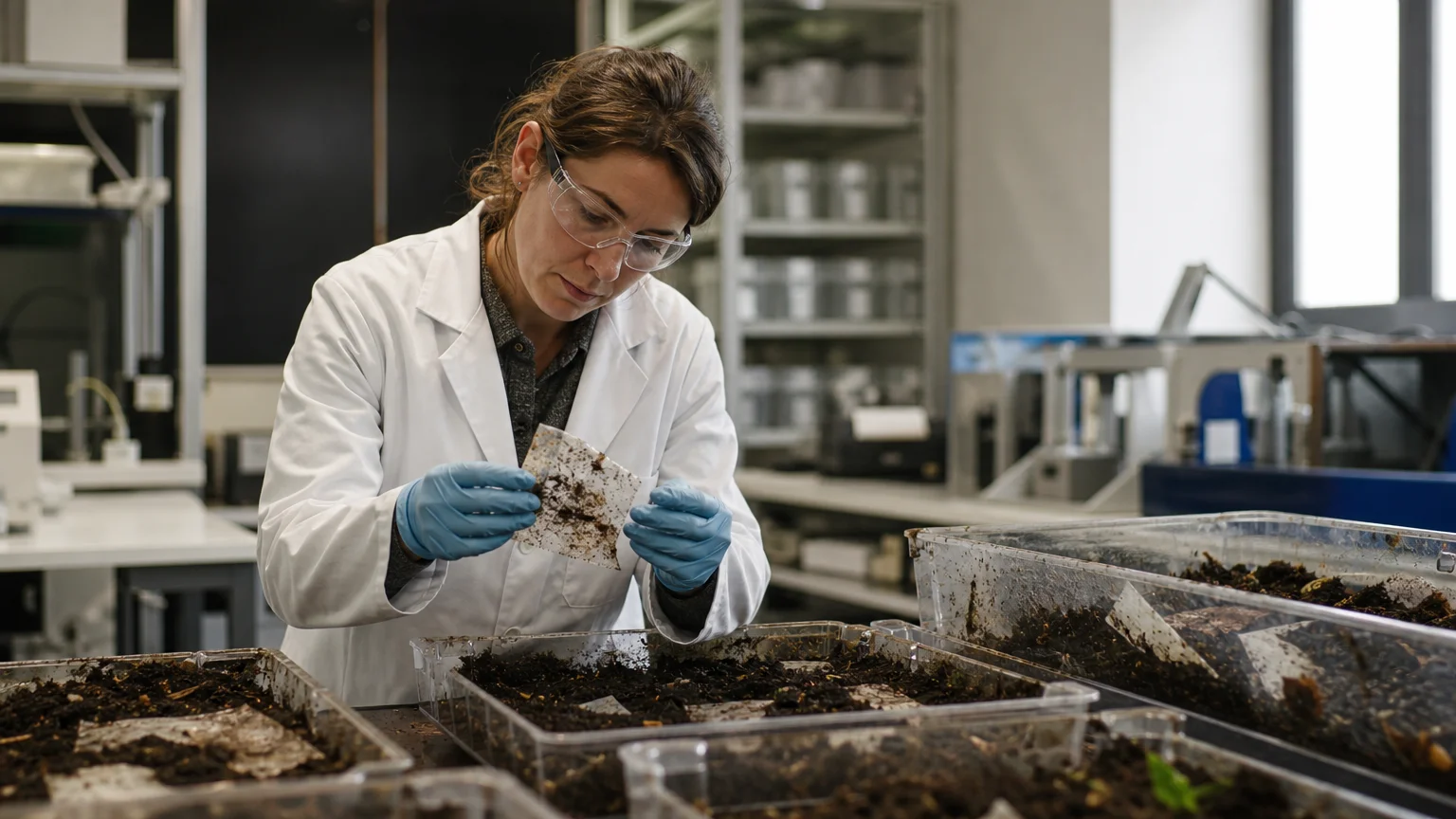
After 12 weeks in a composting environment, no more than 10% of the original mass should remain on a 2 mm sieve. This ensures the material physically breaks apart at a rate compatible with the composting cycle. Thick films and rigid packaging often fail here if not specifically formulated for compostability.
3. Ecotoxicity
The compost produced from the material must not harm plant growth. Testing measures germination rate and biomass output of two plant species grown in compost made with the candidate material versus control compost. The material must produce results within 90% of the control.
4. Heavy Metal and Chemical Limits
EN 13432 sets maximum concentrations for 8 heavy metals (including lead, cadmium, mercury, and chromium) and restrictions on fluorine and other regulated substances. The material must stay below these thresholds to protect the quality of compost used in agriculture.
How to Verify a TÜV Austria Certificate Is Real and Current
Certificate fraud in the compostable products space is a real problem. Some suppliers display the OK Compost logo on packaging without holding a current, product-specific certificate. Here is a four-step verification process.
Step 1: Check the TÜV Austria Online Database
TÜV Austria maintains a public OK Compost certificate database at its official website. Search by company name or certificate number. A valid certificate will list the exact product type, the mark scope (INDUSTRIAL or HOME), and the expiry date. If the company or certificate number does not appear, the claim is not verified.
Step 2: Match the Product Type Exactly
Certificates are issued per product type or product family. A certificate for compostable bags does not cover compostable gloves, and vice versa. Ask the supplier for the certificate document, not just the logo. The certificate header should name the specific product model or category it covers.
Step 3: Check the Expiry Date
OK Compost certificates are typically valid for one to three years and require renewal testing. An expired certificate means the supplier is no longer actively maintaining compliance. Always confirm the expiry date is in the future at the time of your order.
Step 4: Request the Underlying Test Report
The certificate itself confirms the status, but the third-party EN 13432 test report shows the actual data: biodegradation percentage at each time point, ecotoxicity results, and heavy metal analysis. Sophisticated buyers ask for this report to confirm the material genuinely passed all four criteria, not just the certification summary.
What Worldchamp Holds for Compostable Products
Worldchamp (HuiZhou) Plastics Products Co., Ltd. has been producing certified compostable disposable products since 2021. Here is what our compostable product line holds and what the certificates actually cover.
| Certificate | Number | Scope | Mark family |
|---|---|---|---|
| DIN CERTCO Compostable | 9G0275 | Compostable gloves only (industrial composting) | EN 13432 |
| SEEDLING Compostable | 7P1218 | Compostable gloves only (industrial + home composting) | EN 13432 + OK Compost HOME |
| BPI Compostable | Certificate 10529018-3; sublicense 2486563-4 | Only the WPP-GL001 / Planetgards glove SKUs listed in the current sublicense | ASTM D6400 |
Important scope note: certification evidence is product-specific. The current BPI sublicense is valid through April 30, 2028 and lists only three Planetgards glove SKUs manufactured as WPP-GL001. It cannot be generalized to other gloves or bags. Our compostable bags line is supported by a Biodegradable Plastic Bag Inspection Report (Report No. WT20103211073930WT1, issued by Shenzhen Academy of Metrology & Quality Inspection, CNAS-accredited). That is a third-party test report, not a TÜV Austria or DIN CERTCO certification. We state this clearly so your compliance documentation accurately reflects the product scope.
Our facility operates across 12,000 m² in Huizhou, Guangdong, with a monthly output of 350 tonnes, including the compostable product line. Factory quality is covered by BRCGS Consumer Products Certificate No. CN-BRCCP-251634 and ISO 9001 Certificate No. 77067/A/0001/UK/En. These factory certificates confirm quality management, not product compostability.
Procurement Action Checklist
- Define your disposal route first. Know whether your end users have access to industrial composting facilities or only home compost bins. This determines which OK Compost mark you need.
- Request the certificate document, not just the logo. Ask the supplier for the actual TÜV Austria or DIN CERTCO certificate PDF, check the product scope, and verify the number in the official online database.
- Check the EN 13432 test report. Confirm the underlying test data shows passing results on all four criteria: biodegradation rate, disintegration, ecotoxicity, and heavy metal limits.
- Clarify scope boundaries. Confirm the certificate covers the exact SKU you plan to order — not a related product, not a previous model, and not a different material weight or thickness.
Frequently Asked Questions
What is TÜV Austria compostable certification?
TÜV Austria is a certification body based in Vienna, Austria, that licenses the OK Compost mark family for compostable products. Their marks — OK Compost INDUSTRIAL and OK Compost HOME — are based on the European standard EN 13432. A product carrying one of these marks has passed independent testing for biodegradation rate, disintegration, ecotoxicity, and heavy metal limits.
What is the difference between OK Compost INDUSTRIAL and OK Compost HOME?
OK Compost INDUSTRIAL certifies a product for professionally managed composting at elevated temperatures (58°C or higher). OK Compost HOME certifies a product for degradation in ambient backyard compost bins. HOME certification imposes stricter performance requirements because the composting conditions are less controlled. A product certified for HOME will also meet INDUSTRIAL requirements, but not vice versa.
Is TÜV Austria the same as TÜV Rheinland?
No. They share the TÜV name but are separate, independent organizations. TÜV Rheinland (Germany) focuses on product safety and electrical equipment. TÜV Austria (Vienna) specializes in bioplastics, biomass certification, and the OK Compost mark program. A TÜV Rheinland certificate does not verify compostability.
What does EN 13432 actually test?
EN 13432 tests four things: the rate of biological decomposition (90% carbon conversion within 6 months), physical disintegration (less than 10% remaining after 12 weeks on a 2 mm sieve), ecotoxicity of the resulting compost (plant growth within 90% of control), and concentration of heavy metals and regulated chemicals. All four criteria must pass for certification.
How do I verify a supplier’s TÜV Austria certificate is real?
Search the supplier’s name or certificate number in the TÜV Austria public OK Compost database. Confirm the certificate covers the specific product you plan to order (not just the company), check the expiry date is current, and request the underlying EN 13432 test report to see the actual test data.
Does Worldchamp hold a TÜV Austria compostable certificate?
Certification scope is product-specific, not factory-wide. Ask for the current certificate or test report, then verify the holder, certificate number, standard, exact material or finished SKU, target market, validity dates, and permitted claim before approval.
Put this guide into a procurement workflow
Use the decision criteria above to narrow the product scope, then Compostable Garbage Bags Bulk Supplier, Compostable Shopping Bags Wholesale Supplier, and Compostable Specialty Bag Sourcing. Compare the exact construction and pack instead of approving a material name alone.
When the product direction is clear, discuss the specification with Worldchamp. Share the task, destination, quantity, packaging and evidence requirements so the next review is specific.
Turn the comparison into a sample and document brief
Share the application, market, quantity, pack format and scope of supporting documents. Worldchamp can then respond against a defined product rather than a generic material request.