Food-service sourcing / Material selection
PE vs Vinyl Gloves for Food Service
Compare polyethylene vs vinyl gloves for food-service tasks, fit, changeovers, product documents, and fair cost checks before approving your next order.
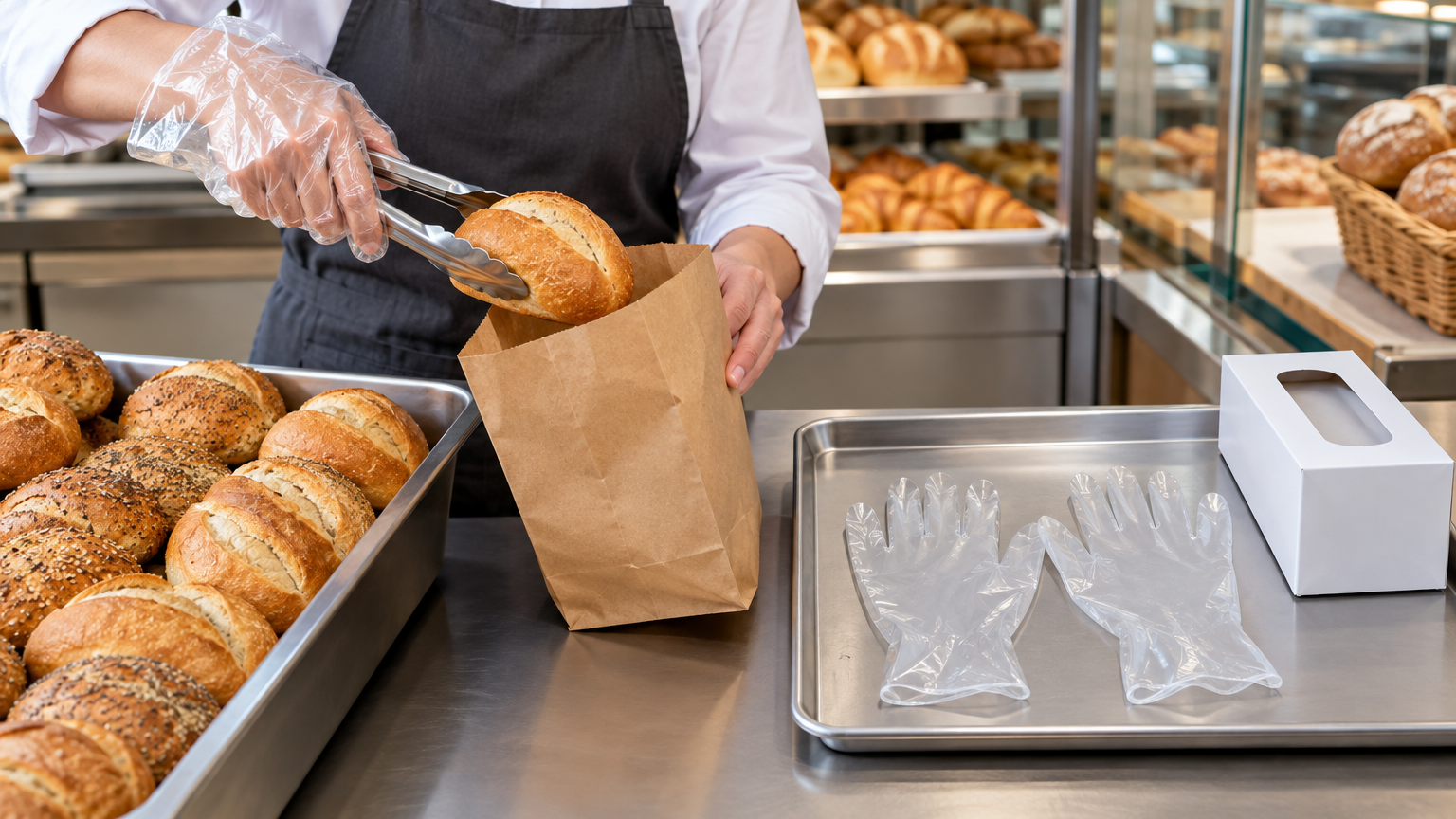
Polyethylene vs Vinyl Gloves Starts with the Food Task
The practical question in polyethylene vs vinyl gloves is what happens between putting a glove on and throwing it away. A bakery assistant packing bread, a sandwich maker arranging fillings, and a worker handling raw poultry have different contact patterns. Buying one material for every station can hide those differences. Start with the task sequence, not the carton price.
Polyethylene gloves are commonly made from film with a sealed outline and a relatively loose hand shape. Vinyl gloves are made from plasticized polyvinyl chloride and are commonly offered in a more shaped fit. These descriptions explain typical construction, not guaranteed performance. Dimensions, formulation, surface finish, manufacturing quality, and the specific model all affect the finished glove.
- For brief bread or pastry handling, examine easy dispensing, cuff opening, and clean removal.
- For sandwich assembly, check finger control, food release, and the ability to handle small ingredients.
- For raw animal foods, define separation from ready-to-eat work and the required change points before comparing gloves.
- For hot equipment, knives, or concentrated cleaners, assess separate protective equipment rather than choosing between these two disposable materials.
Record whether hands touch food directly or mainly operate utensils. Include task duration, food temperature, and wet or greasy contact. Then compare the available disposable glove materials and formats against that written brief. A glove that works for packing dry rolls may not suit a longer, more demanding preparation sequence.
Compare PE and Vinyl in Your Actual Work
Compare how the gloves handle in your work, then check the specifications for each model. Do not assume every PE glove is thinner than every vinyl glove, or that one material always provides a better barrier. Compare the actual offered models. Even two gloves with similar stated thickness can have different dimensions, seams, surfaces, and behavior during use.
| Decision point | Polyethylene candidate | Vinyl candidate | What to verify |
|---|---|---|---|
| Short, repeated handling | Loose film formats may simplify removal. | A shaped fit may offer more finger control. | Observe dispensing, donning, and removal in the same sequence. |
| Small ingredient placement | Loose fingertips may need adjustment. | Correct sizing may reduce excess fingertip space. | Check placement accuracy without touching the glove exterior. |
| Wet or oily foods | Surface and construction affect handling. | Formulation and surface affect handling. | Review contact conditions and test the actual food task. |
| Repeated changes | Pack presentation can support access. | Size availability can affect donning. | Count wasted gloves and observe correct changeovers. |
| Food-contact suitability | Requires evidence for the finished model. | Requires evidence for the finished model. | Match documents to the destination market and intended use. |
Within PE, compare HDPE glove options and LDPE glove options as distinct purchasing candidates. Their product names do not establish a universal ranking for strength, comfort, or food safety. Ask for the offered dimensions and construction, then retain a reference sample. Reordering by material name alone can overlook a change that staff notice immediately.
Fit Should Support Correct Changes, Not Longer Wear
Fit affects how a worker completes the task and how readily the glove can be replaced. Excess material at the fingers can interfere with picking up small toppings. An overly tight glove can restrict movement or make donning difficult. Ask staff with different hand sizes to open containers, use utensils, and reach into the normal workstation layout.
A closer fit does not justify wearing the same pair across unrelated tasks. Moving from raw food to ready-to-eat preparation, touching a phone, or handling waste creates a different hygiene situation. Define change rules with your food-safety lead and local requirements. Gloves do not replace handwashing, and disposable gloves should not be washed for reuse.
- Position the dispenser where staff can reach clean gloves without crossing a dirty work area.
- Check that workers can remove a glove without transferring contamination to bare hands or nearby supplies.
- Make suitable sizes or dimensions available rather than asking everyone to tolerate one fit.
- Replace gloves when damaged or contaminated, and at the change points established for the task.
Watch actual changeovers rather than timing donning in isolation. A convenient opening is valuable only if the glove stays usable through its assigned task. Likewise, a comfortable glove is not an excuse to postpone replacement. When reviewing polyethylene vs vinyl gloves, favor the model that supports the required routine with fewer handling problems, not the model that encourages the longest wear.
Check Food-Contact Reports for the Finished Glove
Check food-contact suitability for the finished glove and its intended use, not just the material. Request documents that identify the manufacturer, model or sample, applicable requirements, and test conditions. Check whether the evidence concerns finished gloves or only a resin ingredient. Do not use another model's report as proof for the glove you are buying.
Describe the foods, expected contact time, and temperature before asking a supplier to confirm suitability. Fatty foods, aqueous foods, and different contact conditions can require different supporting assessments. For vinyl, ask how the formulation and applicable substance restrictions are addressed. For PE, do not assume the polymer name resolves every additive or finished-product question.
- Match the sample and quotation to a clear product code and specification revision.
- Check the report date, issuing laboratory, sample description, methods, and reported conclusions.
- Ask the supplier to explain the intended market and any stated limits or exclusions.
- Retain the accepted documents with the purchase specification and request notice of relevant changes.
Distinguish a test report from regulatory approval or a company management certificate. An ISO quality-management certificate does not by itself establish food-contact suitability for every glove. Our food-safe glove purchasing guide develops this document-first approach. If a report is incomplete or mismatched, resolve the gap before shipment rather than replacing evidence with a broad claim such as food grade.
Keep Food Handling Separate from Chemical and Medical Protection
A glove chosen for food handling should not automatically become the glove for cleaning chemicals, hot trays, or sharp tools. These tasks need their own hazard assessment and product evidence. The relevant question is not whether vinyl sounds stronger than PE. It is whether the specific glove has suitable performance for the exposure and working conditions.
OSHA's hand-protection selection requirements call for evaluating performance against the task, conditions, duration, and identified hazards. This is a worker-protection rule, not a food-contact approval list. For a cleaning product, review its safety information and glove compatibility evidence for the actual concentration and exposure. Do not invent chemical resistance from the material label.
Medical suitability is another separate question. The FDA's medical glove guidance explains that medical gloves are regulated medical devices and warns that sharp objects can puncture them. A food-service glove is not an examination glove simply because both use vinyl, nor does any disposable material name establish medical authorization.
For demanding handling that falls outside the approved PE or vinyl candidate, evaluate another documented option rather than forcing a binary choice. The PE versus nitrile food-service comparison offers a separate selection discussion. Keep cut protection, heat protection, chemical protection, and food-contact suitability as distinct checks, even when a workstation requires more than one of them.
Calculate Cost Under the Same Operating Conditions
Compare cost per completed task only after both candidates meet the required specification and hygiene routine. A cheaper carton may contain fewer gloves or incur different freight and import charges. A higher quoted price may include different packaging or sizes. Put every quotation on the same currency, delivery basis, quantity, and count before drawing a conclusion.
Cost per completed task = [(landed cost per glove × all gloves issued) + glove-change labor cost + attributable disposal cost] ÷ completed tasks. Define landed cost per glove as the comparable delivered purchase cost divided by the verified glove count. Count gloves individually, not pairs, unless both quotations explicitly use pairs. Include unused gloves discarded during dispensing in gloves issued.
- Use the same task definition, staff mix, food conditions, and required replacement rules.
- Calculate change labor from observed change time and the same loaded labor rate.
- Include only disposal charges actually attributable to the comparison, using the same method.
- Record quoted costs separately from trial measurements so another buyer can check the calculation.
Do not create savings by reducing required glove changes, excluding hand hygiene, or assuming a glove lasts longer without task evidence. If disposal cost cannot be measured reliably, show it as excluded for both candidates. Report a range when observations vary. A trial can reveal dispensing waste or donning difficulty, but it cannot promise a universal percentage saving for polyethylene vs vinyl gloves.
Test Samples and Check Your Supplier's Product Range
Compare samples under the same conditions before placing a full order. Use normal dispensers and representative staff, including different hand sizes. Set acceptance criteria before the trial: usable fit, required task completion, correct changes, acceptable dispensing, and no observed damage during the assigned work. Record problems by model and task rather than summarizing everything as staff preference.
- Check incoming samples against the proposed dimensions, packing count, and product identification.
- Trial both candidates under comparable food-contact and workstation conditions without relaxing hygiene rules.
- Log donning problems, visible damage, unwanted food sticking, wasted gloves, and worker comments.
- Review product documents alongside observations, then retain an approved sample and written specification.
This operational trial does not replace food-contact testing or prove protection against invisible hazards. Stop using a sample when damage or another unacceptable condition appears. If the specification, formulation, or factory changes, assess whether renewed documentation or sampling is needed. Routine incoming checks should confirm that production shipments remain consistent with the accepted reference.
Worldchamp manufactures disposable film products, including HDPE, LDPE, CPE, TPE and POE gloves. For a vinyl comparison, obtain a clearly identified candidate and supporting evidence from its actual supplier. Use our wholesale glove sourcing information to prepare a PE inquiry with your task, destination market, dimensions, packaging format, and document requirements. Ask for a specific sample proposal rather than a blanket material recommendation.
Frequently Asked Questions
Can I alternate PE and vinyl gloves at different food-service stations?
Yes, a station-specific purchasing plan can be appropriate when each model is documented and suitable for its assigned use. Label storage locations and train staff on which glove belongs to each task. Avoid mixing models in one dispenser, because that removes traceability and makes fit or complaint investigations harder. Keep replacement and handwashing rules consistent with the food-safety plan.
Does a blue glove provide better food safety than a clear glove?
Color can support visual identification or a site's task-separation system, but it does not establish food-contact compliance or barrier performance. Confirm the offered color is included in the relevant product specification and evidence. If the operation needs detectable gloves, request specific detection capability and validation; ordinary blue coloring does not demonstrate metal or X-ray detectability.
What should a distributor do when a supplier changes glove packaging?
Confirm whether the change affects only artwork or also glove count, dispensing method, product code, dimensions, or formulation. Update warehouse and customer records so old and new packs remain distinguishable. If dispensing changes, repeat the relevant workstation checks. Recalculate the comparable unit cost when pack count or logistics changes, even if the carton price stays the same.
What information should I send Worldchamp for a PE glove sample request?
Send the food-service task, destination market, food-contact conditions, preferred dimensions, estimated quantity, and dispensing or retail format. Include required documents and any current sample problems, such as loose fingertips or difficult cuff opening. For vinyl comparison samples, contact a supplier offering the specific model you intend to test.
Tell us what you need from your PE gloves
Send the task, target market, hand sizes, packaging and estimated quantity. We will confirm the proposed PE product, available documents and sample arrangements for comparison with your current glove.
Discuss a PE sample